An in-depth look at the history of the truss rod and all of the related topics, including neck bow, string tension, action, relief, setups and more.
As far as anyone knows, the first instrument strings were made of catgut, or cattle intestine ("cattle" being a general term for domesticated herd animals such as cows, sheep, goats, etc.). From what we are told, this technology dates back to ancient Egypt.
Catgut (or "gut") strings are known for their warmth and responsiveness to touch. They may be found on most any stringed instrument, from violin to harp to Spanish guitar. However, they are very subject to environmental changes, and must be diligently maintained to prolong costly replacement.
Most plucked gut string instruments having wooden braced soundboards (and the list is vast across time) featured "ladder" bracing patterns. German-born Christian Friedrich Martin, apprentice to Johann Georg Stauffer in Vienna, Austria, emigrated to the United States in 1833. He began his independent lutherie career by building ladder-braced guitars in the Stauffer tradition.
In the 1840s Martin, in conjunction with John Coupa, discovered and adopted the move to "fan-braced" patterns, developed by the Spanish builders. We read that by 1847, Martin & Coupa, along with (Louis) Schmidt & (George) Maul, were experimenting with guitars featuring an "X-braced" pattern, though it would be Martin, alone, who would later be credited for popularizing the X-brace. All of these guitars were being strung with catgut.
The drawings, below, are apparently representative of Martin and Coupa's collaborative bracing experimentations over a 12-year period, from 1833 to 1845.
In the photo, below, we see an early Martin X-braced instrument, the Spanish 1 Model 28. The instrument is alleged to be from the 1840s. Notice the bridgeplate, which features bridge pin holes. Steel strings wouldn't be introduced for another 50+ years. These would have been gut strings that were pinned.
In the early 1900s, the Martin Company's first catalogued steel string guitars were the Koa "Hawaiian" models, private labeled for both the Oliver Ditson Company and the Southern California Music Company. These guitars were being offered in a variety of sizes that ranged from 11-1/8" across the lower bout to 15" (for the 000).
In 1916, apparently at the behest of Harry Hunt of the Ditson Company, the Martin Company introduced the 12-fret and 14-fret "D" model, what we now know as the dreadnought. While it was only 5/8" wider than a 000, the body was longer and deeper, and the waist was a bit wider.
Fascinatingly, ALL of these guitar models (including the dreadnoughts) featured fan-bracing, not X-bracing. From what I gather, the X-brace would not begin replacing fan-bracing on steel string guitars until 1924.
Spanish luthier Antonio de Torres Jurado, a gut string builder, is rightly credited with popularizing the shape and sound of what we think of today as the Spanish (or "Classical") guitar. Trained as carpenter, his lutherie career began in the 1850s.
Much like C.F. Martin, Torres is responsible, not for inventing, but for cleverly combining improved elements and recent innovations in guitar construction. Torres standardized a refined body shape and depth, a thinner and domed soundboard, and more refined and symmetrical fan bracing. The result was a vastly improved instrument that set the standard for others to follow, including Martin.
Knowing these details, if the X-brace was actually introduced in the 1840s, more than a half a century before steel strings existed, at a time when guitars were strung with gut, history demonstrates that such a design obviously couldn't compete tonally or in loudness with the Spanish fan-braced instruments. Small-bodied guitars simply sounded better with fan-bracing.
Fact: The X-brace wouldn't catch on for another 75 years, 24 years after the introduction of steel strings, and 50 years after C.F. Martin's death. But "catch on" it did!
Up to this point, guitar necks had remained largely "un-trussed", relying solely on the inherent stiffness of the wooden neck alone to properly support the pull of the strings, while maintaining a playable action. Action and relief existed as the carefully balanced relationship between the tension of gut strings and the engineered stiffness of the neck.
The increasing public demand for steel string instruments pressured builders of the day to address the newfound issue of excessive forward bow in the neck, and they began experimenting with various stiffeners made of wood or metal. Little more than 20 years after the introduction of steel strings in 1900, an event occurred that marked a significant shift in the way steel string guitar necks would be constructed.
In 1921, Thaddeus McHugh filed a patent for an improved "Neck for Musical Instruments". The patent identifies him as the inventor, though a document further identifies him as "assignor to Gibson Mandolin and Guitar Company", meaning McHugh "assigned" ownership to Gibson.
In his application, McHugh explained that the problem he was solving was due to the strings pulling the headstock forward ("The pull of the strings tends to swing the outer end of the neck upward ..."). McHugh's goal, as identified in the patent, was to improve the neck through the use of the truss rod.
His solution involved pressing a rod, threaded on both ends, into a convex channel cut into the neck. The rod was secured on one end through a horizontal hole cut into the headstock, and on the other end through a hole cut into the tenon of the neck. A filler section, cut with a matching concave curve, was added atop the rod to fill the channel.
Tightening the rod would compress the back of the neck between the headstock and the heel, forcing the already-bowed rod to bow even more, resulting in moving the fretboard closer to the path of the strings ("... the action of the truss is to bow the center of the neck upward"). The neck would effectually arch backwards.
According to McHugh, necks utilizing these truss rods would not be prone to "spring or warp", and any neck that did happen to fall prey to the "strains to which it is subjected" could be straightened. He further stated that the rod could be used to "... regulate the distance of the strings from the keyboard."
Keyboard? Yup. That's how the patent referred to the fretboard. But perhaps the claim that would have the greatest impact on guitar construction, going forward, was the following statement and the reason why, today, intrinsic neck stiffness is not a factor in the construction of the acoustic steel string guitar:
I am also enabled to use wood which has not been heretofore considered satisfactory for the manufacture of necks, on account of it not having sufficient strength and rigidity, and further, great care in selecting stock is not necessary."
Wow! This was no small change in direction! For the makers of the modern acoustic guitar, neck stiffness is simply not measured, not taken into account. We know we can just throw a steel machine into a wooden neck and counter whatever bow may occur, at will!
Rather than adopt the new path taken by Gibson (a certain 1923 patent may or may not have been involved in that decision), Martin attempted to mitigate the problem by embedding an Ebony beam beneath the fretboard, which proved to be only marginally successful. Martin replaced the Ebony stiffeners with metal T-bars which, apparently, worked rather well. These T-bar stiffeners were later replaced with steel square tubes.
I would like to add one final point to this over-simplified history: Nylon, a plastic, did not become available in the form of guitar strings until after WWII. For the first 50 years of their existence, steel strings were not competing against nylon strings. The alternative to steel strings was catgut.
Here are 4 common guitar string materials available, sorted by tension:
To recap, the earliest neck trusses were simply heavy, hardwood stiffeners. Being wood, they tended to be subject to the same environmental factors the rest of the neck is subject to, though perhaps to a lesser degree. Martin, recognizing the growing popularity of steel strings in the early 1920s, added an Ebony stick beneath the fretboard in an effort to compete with the increase in string tension.
Stronger than wood, metal stiffeners soon replaced their wooden predecessors. Martin replaced the Ebony stiffener with a steel T-bar in 1934. But for short period during WWII, when steel was unavailable, and Ebony was used again, the T-bar was the stiffener of choice until 1967. At that time, the company made the change to 3/8" square metal tubes. These would remain the neck stiffener of choice at Martin until the mid-'80s. Other manufacturers experimented with angle iron, steel I-beams, U-channels, and more, all in concerted effort to resist the inevitable forward bow of the neck caused by the tremendous pull of the strings.
NOTE: The term "non-adjustable" refers to the stiffener, specifically, not the neck, in general. A neck fitted with a fixed stiffener that was (is) experiencing excessive forward bow could, up to a point, be "adjusted" using a technique that came to be known as "compression fretting". One or more frets could be replaced with frets having slightly wider tangs. This would induce a backbow in the neck, with the objective being to find equilibrium between the string tension wanting to curl the neck forward and the expanded fret slots working to bow the neck back. Hopefully this balance would occur somewhere in the range of a playable action.
Fixed stiffeners, both wood and metal, shared the same drawbacks. They were heavy, adding noticeable weight to the guitar neck. Most significantly, necks fitted with them were still subject to bowing. To keep metal stiffeners light enough to be practical for use, they were thin enough to bend with sufficient force. Worse, once bent, they could only be repaired with major surgery.
Fixed stiffeners eventually fell out of favor as more and more builders adopted emerging adjustable solutions. Martin did not make the switch to adjustable truss rods until 1985.
I believe that the fault of those early fixed stiffeners, their inability to successfully resist the forward bow induced by the greater tension of the steel strings in the way that we had seen in the symbiotic relationship between necks and gut strings for centuries prior, was one of material availability, not the lack adjustability. More on this, later.
1-Way adjustment
After WWII, after Gibson's patent had expired, other builders incorporated their own versions of the compression rod. Guild inverted the design. Similar to Gibson, Guild anchored the rod (or both rods, as was the case for their 12-string necks) in the heel, and exposed the opposite end at the headstock for adjustment purposes.
Instead of pressing the rod into a convex curve, Guild pressed it into a shallow concave curve. Tightening the rod had the effect of forcing the headstock back down.
Modern versions of the compression rod may thread into a barrel bolt on the end that is to be retained, where older versions featured a peened rod against which a thick, rolled washer is affixed, even welded in many cases.
The introduction of the adjustable compression rod had removed the need to labor over the construction of a stiff neck. The negative effects of string pull could now be relegated to the metal truss rod.
Eventually, this permitted the builders to design very slender necks which were (and still are, ironically), extremely susceptible to excessive bow caused by string tension. From this point in guitar history, forward, guitar makers would no longer even consider building a steel string instrument without an adjustable truss rod.
Raised action due to excessive forward neck bow could now be addressed AFTER the guitar was completed! A builder didn't have to just live with the results of poor calculations, poor material, and/or poor construction.
Being able to force very supple necks flat and set lower and lower actions on steel string instruments re-introduced an old nemesis, namely, string buzz. However, with the mere turn of a wrench, relief could be set after the strings were installed and tightened to pitch, and the buzz could be mitigated.
The compression rod proved to be quite effective over the years, but it was not without fault. By design, the embedded rod is held in a pre-determined curve based on an educated guess regarding the future movement of the neck.
The rod can only move from its original, slightly bowed position toward straight, at best, and things change. Over time, the compensation effected by the tightening of the compression rod may no longer be sufficient. This is evidenced by the countless repairs, where a compression rod has had additional threading applied (or washers added) in order to effect greater pressure.
Over-tightening often results in a snapped rod, a very undesirable condition. Due to the one-way adjustability of the design, it is often difficult (if not impossible, without special jigs followed by a refinishing effort) to return the neck to the straight, dead-flat condition needed for fretboard/fret work, setups, etc.
When the compression rod hasn't broken (yet), and the threads haven't stripped (yet), over-tightening has often been responsible for producing a visible split down the back of the neck which may or may not be easily repaired.
The next advancement in neck truss technology was the invention of the single-action (or single acting) truss rod. Like the compression rod, the single-action truss rod employs a uni-directional adjustment to counter the forward bow of the neck resulting from the pull of the strings.
Unlike the compression rod, it is a self-contained machine, requiring only a rectangular slot in which to reside beneath the fretboard. It is not fixed to either end of the neck, nor does it need to be compressed into a curve. It is installed flat and adjusted after the strings go on.
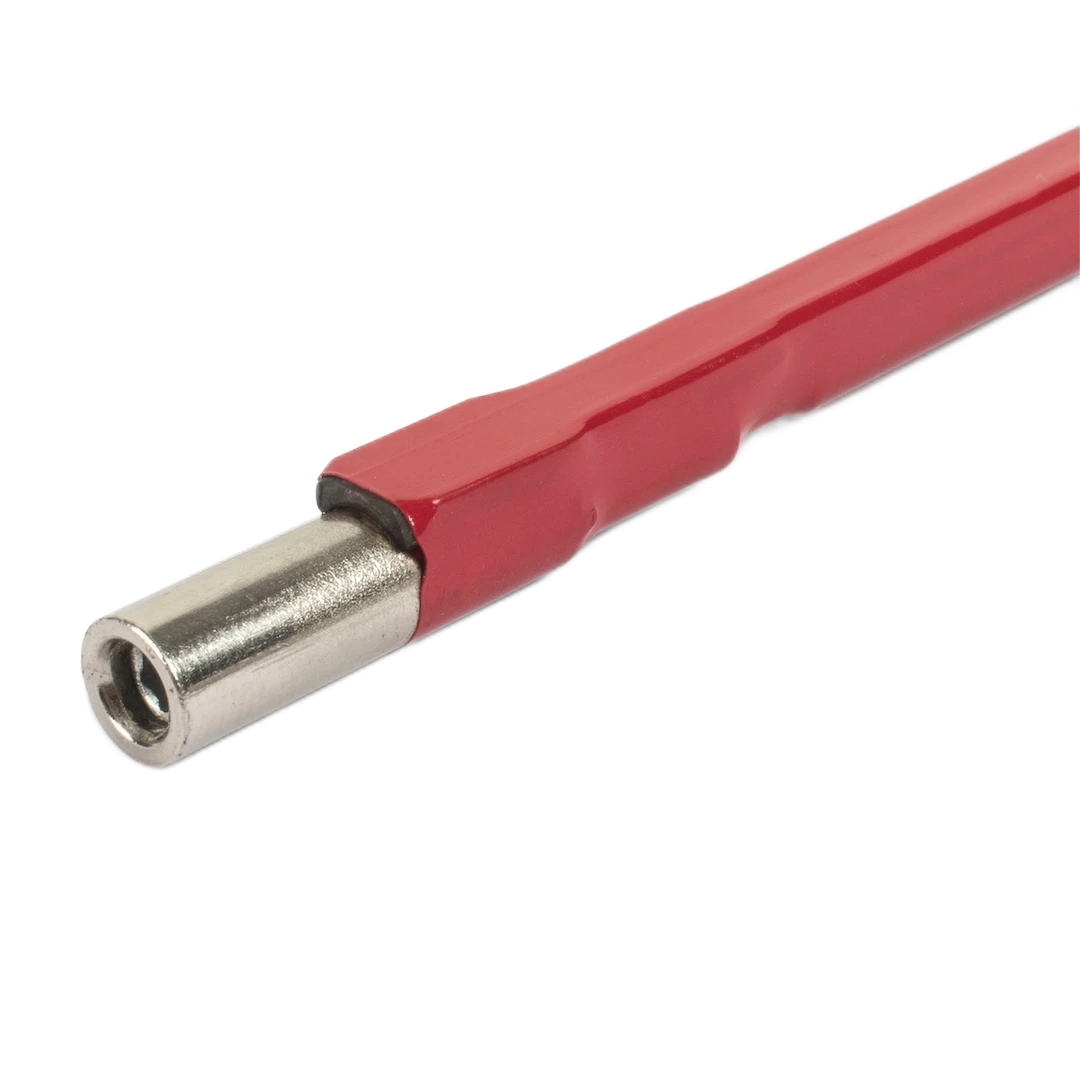
A single-action truss rod is comprised of two parallel rods, one slightly longer than the other, that are joined at one end (two rods may be welded together, or one long rod may be heated, folded in two, and hammered tightly together). At the other end, one rod is fixed into a block through which the second, longer rod passes.
The end of the longer rod is threaded and, as a nut is tightened against the stop block (into which the shorter rod is terminated), a bow is developed; concave for the longer rod and convex for the shorter. Early rods rattled. To prevent the unwanted noise, later versions were bound together with tape or a sleeve made of heat-shrink material.
Installed flat into a slot in the neck in such a way that the longer rod (the rod having the adjusting nut) is farthest from the fretboard, tightening the nut of this style of truss rod will introduce a back bow in the neck. If you were to reverse the installation, and rotate the rod 180° along its length (turn it "upside-down") in the neck slot where the longer rod (the rod having the adjusting nut) is up against the fretboard, tightening the nut would result in a forward bow in the neck.
These rods were easier to install than their compression rod forbearers, as well as being easier to repair. They could even be installed from the back of the guitar neck!
REMINDER: Rods can snap, welds can fail, threads can strip, and necks can split, so it is important to make small adjustments with care.
As with the compression rod, the single-action truss rod provided some control over relief. If either or both of these fixtures had/have a drawback, it was/is the increasing need to remove any remaining stiffness in the neck/fretboard/fret combination. Why? Essentially, both fixtures are a one-way street.
You tighten them to counter forward bow. But what do you do if, for example, you decide to install uber-super light gauge strings, only to discover that your neck isn't bowing far enough forward to overcome fret buzz? Wouldn't it be nice to be able to turn that hex key in the opposite direction and, instead of seeing nothing happen, watching the neck curl forward a bit?
2-Way adjustment
Can one truss rod manually induce both a forward and back bow in a guitar neck without having to be un-installed, rolled over 180° and re-installed? Enter the pinnacle of truss rod achievement, the dual-action (double-action, double acting, twin-action, etc) truss rod. Its self-contained, two-way adjustability overcomes the uni-directional limitations of both the single-action truss rod and the compression rod and provides a greater degree of neck bow control.
Turn one direction to induce a forward bow, and turn the opposite direction to bow the neck backwards. This reversing of direction is accomplished by threading the rod through the stop block, as opposed to simply passing it through a hole in the stop block, as is the case with the single-action truss rod.
Below is a simple illustration showing an exploded view of the components of a dual-action truss rod:
The dual-action truss rod quickly became the end-all-be-all solution for those who desired precision control over relief.
Along with ease of installation, requiring only a simple, straight channel, it is understandable how this design skyrocketed it to truss rod super-stardom. For some models, more neck material may need to be removed to accommodate it and, unlike the compression rod, the channel it occupies must be left open perpetually requiring greater care when attaching the fretboard.
Depending on the manufacturer, some models may be heavier than their single-action cousins, and may require more neck material to be removed. Some versions have been known to introduce the dreaded intermittent "rattle".
As with any steel truss rod of adjustable design, the dual-action truss rod is subject to failure (welds, stripped threads, snapped rods, etc).
Despite its shortcomings, the the dual-action truss rod is ubiquitous today. I think it is safe to say, the dual-action truss rod is here to stay.
Non-adjustable {gasp!} Does this mean that we're regressing?
The use of carbon fiber for stringed instrument neck reinforcement is now several decades old, and I find it easy to understand why. The fact that carbon fiber typically weighs less than the wood it replaces, and is certainly many times stiffer and stronger, can be reason enough to incorporate it. Fibers comprised of long chains of carbon atoms are embedded in a matrix of epoxy resin resulting in material having properties similar to steel with the weight of a plastic. Very cool stuff!
Steel and plastic are said to be homogeneous and isotropic, meaning their properties (mechanical, electrical, thermal, etc) are equal at all points, in all directions, throughout the material. Carbon fiber, on the other hand, generally exhibits strength along the axis of the fibers only, similar to wood being stiffer along its grain. When needed, carbon fiber can be specifically constructed to approach isotropic (called "quasi-isotropic") properties by layering the laminates in off-axis direction (think: plywood).
In what may approach a quintessential case of irony, many guitar makers have recognized the advantage of restoring intrinsic stiffness to their guitar necks. By supplementing an adjustable truss rod with parallel bars of carbon fiber stiffeners that run the length of the neck, a stronger (more rigid, more stable) and lighter design is achievable.
Relief may be one of the most misunderstood topics in the world of acoustic guitars.
Relief is a secondary reason for the need for an adjustable truss rod, the primary reason being that few want to build a neck stiff enough to survive string tension without using a truss rod.
Relief, independent from action, refers to an alteration of what would otherwise be a perfectly flat plane formed across the surface of the frets, acknowledging an existing or inducing a deliberate concave, shallow recess (or curve) in that plane, which ever-so-slightly increases action - after action has been correctly established against the perfectly flat plane of the frets.
Put much more plainly: Relief is the existence of a slight forward bow in the neck. 😏
On the acoustic steel string guitar, the presence of relief, contrasted with having a perfectly flat fret plane, might be helpful under certain circumstances, for certain players, in reducing string buzz resulting from extremely low action setups, reduced tension (lower-than-concert pitch) tuning(s), heavier gauge strings, aggressive plucking or strumming, etc.
Relief existed for centuries in one of two ways. In its simplest form, relief could be a natural result of the relationship between the stiffness of the neck and the tension of the strings. Allowing the strings to pull the neck forward "just a little bit", a luthier would rely on the intrinsic stiffness of the wood of the neck to limit forward bow. Don't forget: Martin did this quite successfully until 1985!
However, some early necks could be so stiff that no relief could be effected by the gut strings. In these cases, relief, when desired, could be achieved by physically shaping a shallow contour into the fretboards and permitting the necks to remain dead flat. This knowledge and skill used to fall under the auspices of "lutherie".
When steel strings were introduced, (I believe, but can't prove, that) for a short time, builders hoped to achieve that same symbiotic relationship between the steel strings and necks that they had enjoyed, previously, using gut strings. But the tension of the steel strings proved to be too great for the wood of the neck, alone, to endure. Experiments with fixed stiffeners lasted little more than 20 years before the advent of the adjustable truss rod.
Decades later, with the introduction of the dual-action truss rod, a neck could now be bowed forward or backward at will, several times a minute, if so desired. Relief quickly became a "user-adjustable" feature and the dual-action truss rod grew to be as common as the soundhole.
But don't forget: Martin didn't join the adjustable truss rod revolution until 1985! That means that Martin guitar makers were building on the symbiotic relationship that exists between the tension of the strings and the stiffness of the neck. And they did a pretty decent job of it, considering the materials they had to work with at the time.
In an effort to satisfy as many customers as possible, many acoustic guitar builders sought (and continue to seek) to construct a guitar that will handle any possible playing or setup scenario. For such builders (and, subsequently, most all of the guitar-buying public), an adjustable truss rod is now considered to be a required component.
Ask a better question.
Yes, those predominantly being electric players who, even by electric guitar player standards, prefer extremely low action.
Quite probably. Set up your guitar perfectly, first. Spend a little time on your playing technique. Then get back with me.
Beautiful question! Read on ...
The dual-action (or 2-way adjustable) truss rod hidden inside the necks of so many modern acoustic guitars could be an amazing educator. Unfortunately, it isn't thought of that way. It is used solely as correction device, not as a teaching tool.
Many modern acoustic guitars are constructed and adjusted in the following manner: The completed neck is forced into a flat plane. Frets are installed (leveled, crowned and dressed). Strings are applied and, if the neck bows too far forward, the truss rod is used to bow it back. If the neck stays too flat, the truss rod is used to add some forward bow.
The guitar gets delivered and the unwary public gets to argue the merits of all sorts of topics, guitar-related or not. Few of them understand the purpose or function of the truss rod. The number of guitar owners and players who reach for a wrench to adjust their action is staggering, but pales in comparison to masses who publicly express their cluelessness and ignorance of this metal wonder, and struggle to enjoy their guitars.
Why do I think of the 2-way truss rod as an incredible teaching tool?
Relief is only as necessary as you believe it to be. Beliefs can change, as well as be further justified. And that truss rod can be your guide, your teacher
If your guitar is fitted with one, then use it to learn about the guitar, as well as about yourself. Begin by adjusting the truss rod to take the fret plane to dead flat. If you are using a nut as fret Zero, make certain the bottoms of the nut slots are perfectly at fret Zero's height
Ensure your saddle is holding the strings at A.) Optimal overall string height, measured in front of the bridge and, simultaneously, B.) Your favorite action height, measured at the 12th fret.
If you are unable to hit both of those target numbers with your current bridge and saddle configuration, and/or after modifying your bridge and saddle configuration, then you need a neck reset. Fix that, first, and return to this point.
If you working with an extremely fragile guitar, by all means, continue using the uber-light gauge strings that you have been using. For the rest, if you are not already there, consider moving to medium gauge (0.013" to 0.056") strings. The increase in tension will help to coax the best performance out of your guitar, as well as mitigate string buzz as a result of unwanted fret contact.
But what about relief?
Is your fret plane perfectly flat, having no high or low frets? Are your strings seated in the nut slots at precisely fret zero (not higher, not lower)? If you will set your action no lower than ≈ 0.050" (3/64ths or 1.2mm) and play with a light touch, you can experience the reality of zero relief.
Having a 2-way adjustable truss rod, you can experiment with relief, conscious of the fact that adding relief will raise the action. Minute adjustments may be all that are needed for your most comfortable playing experience.
This exercise may change your belief about relief. While you are self-reflecting, address your playing technique and sharpen your skills. As a player, at the very least, you may realize that having adjustable relief is not as significant an issue as it has been made out to be.
For the builder attempting to deliver a one-size-fits-all product to an unknown audience, well, I understand. And I empathize.
Many are convinced there is a mathematically determined amount of relief, a so-called "optimal" relief, that MUST be set for a guitar, any guitar - all guitars. {Sigh}
I have encountered few who would dare to ever question their belief in relief. It is not a hill I choose to die on. However, I must address the justification that is commonly touted for the existence of the dual-action truss rod, which is the manual machine that is used to effect relief.
Guitar builders install truss rods because (seemingly) everyone believes in the need for adjustable relief. And the #1 reason relief must be adjustable is to accommodate the seasonal effects on our guitar(s).
In other words, relief must be adjustable primarily as a result of having built unstable guitars to begin with! So builders and players alike chase the guitar movement, which all have come to believe is inevitable, by using a truss rod.
The second most popular reason for installing an adjustable truss rod is the (seemingly) unknown relief preference of the new owner. Forget what we know about proper setup and the fact that altering relief alters action height.
CRAZY THOUGHT: What if we were to work to resolve the seasonal movement issue, such as by building a stiffer neck to begin with? What would happen to the main argument for installing a dual-action truss rod? For more on this topic, see my article, » Body Flexion - Neck Block Shift and Soundboard Shear.
CRAZY THOUGHT: What if we were to work to make neck angle a more readily adjustable feature, so action could be corrected properly, at the neck block, instead of assigning the task to an adjustable truss rod?
If you are convinced that you cannot live without relief on your guitar, you may want to explore an understanding of the difference between fixed relief and adjustable relief. It is a big deal, or should be. You can easily work relief into a neck that does not contain an adjustable truss rod.
If you truly want a fully-adjustable neck on your guitar, one which players can bow forward and backward at will, then the decision is made for you: Install a dual-action truss rod and be done with it.
The nut is slotted to hold the strings in their properly spaced position. For most guitars, the base of each slot in the nut also acts as fret #0.
In the event you were unaware of this, the nut can be moved back toward the headstock, using it solely to maintain the spacing of the strings. The strings may then be laid directly across a fret wire installed where the nut used to be/would have been, in that zero fret position on the fretboard.
The strings form a flat plane, extending from fret #0 (or the forward edge of each nut slot) to the crest of the saddle. The measurement of this distance is generally referred to as the scale length (technically, this total distance includes the scale length plus a small amount of compensation). The fretboard, at the time of installation, during a re-fret, and prior to beginning a proper setup, also forms (or should form) a flat plane.
This plane should, at the very least, extend from fret #0 across fret 12 (perhaps 14), if not the entire length of the fretboard. The two planes, strings and fretboard, are not parallel, but they do intersect at fret #0. The strings gradually increase in distance away from the surface of the frets as you move toward the saddle.
The 12th fret wire is (typically) positioned at a point that measures halfway between the nut and the saddle. This is the relative center point of any given length of string and this is where action (the distance between the top of the fret wire and the bottom of the string) is measured.
An un-fretted (or "open") string has the widest swing (or arc, or "oscillation path") when plucked. That widest point happens to occur directly above the center point, the 12th fret. As you fret a string, pushing it down to make contact with the fret wire, you shorten the scale length for that string (temporarily, of course, only until you release the string off the fret).
Subsequently, you alter the string's center point, its position of widest swing, moving that point closer to the saddle. Shorter strings (or shorter string paths created by fretting) will have narrower oscillation paths (they make less-wide arcs, when plucked).
Also, note the relationship between the angle of the two planes (string and fretboard). As you fret a string farther up the fretboard. that string, in addition to having a narrower oscillation path, will have a more acute angle away from the fretboard. To demonstrate this, on a perfectly flat fretboard, simply depress a string against the first fret and measure that string's distance from the second fret. Now depress that same string at the ninth fret and measure the string's distance to the tenth fret.
Note that on the nut side of that induced curl, our little demonstration results in slightly higher measurements until we reach the bottom of the curve. As we start back up the other side of the curve, still fretting in the direction of the saddle, we have slightly lower measurements. That may, or may not, yield the outcome you were expecting.
Truss rods, when used to induce relief (a deliberate forward bow or curl) in the neck, are literally lifting the headstock and, subsequently, fret #0, up and away from their original position. This raises the strings away from the frets, resulting in a higher action.
Using a truss rod to un-curl such a neck, forcing the fretboard flat again, has the opposite effect, lowering the strings back toward the frets. Armed with a hex wrench and the will to wield it, it is no wonder why the typical guitar owner continues to believe that action adjustment is the primary purpose of the truss rod.
IMPORTANT: Using a truss rod to "induce relief" effectually curls a small section of the fretboard between the nut and the heel. It does NOT create a shallow curve between the nut and the saddle.
Pause long enough to consider the actual location of the truss rod in the neck and precisely where its bowing effect occurs (and doesn't occur) in relation to the path of the oscillating strings. Recognize what is happening to the relationship of the plane of the string(s) and the plane across the tops of the frets as you play up and down the fretboard. Acknowledge the proper role of accurate neck geometry and the benefits of a flat fretboard, and you may begin to see the irony of the widespread "belief in relief."
For more insight on this topic, see my article, » The Fretboard Hump.
0.025mm (0.001") is considered to be on the low end of relief, while 0.20mm (0.008") is considered to be high (though many guitars are set to 0.010" and even higher). If you are inducing that much "relief" to prevent the strings from buzzing, you likely are in need of a proper setup made by a qualified technician or luthier. Then again, you may simply be playing too hard.
Perhaps. Or maybe you need a different setup. Or you may want to consider having a second guitar, set up specifically for the purpose.
If your guitar has been made completely of carbon fiber then, no, you probably don't. If your guitar has been made of wood, and the body has been sufficiently rigidified to ignore seasonal changes, then you sound like a perfect candidate for a truss rod replacement using a Dragonplate D-Tube! Otherwise, yes, you probably need a truss rod.
The dual-action truss rod is responsible for introducing what I consider to be an unfortunate discovery, this being that, regardless of ones belief in relief, the height of the plane of the strings off of the fretboard, commonly referred to as action, could be immediately altered with the twist of a key. You may recall that this "feature" was identified in Mr. McHugh's 1923 patent.
Armed with some sandpaper to grind down the underside of the removable saddle and a hex key (Allen wrench) or socket wrench to manipulate the neck of the instrument, anyone could now be an expert guitar setup technician. 😏
We do love our toys. Give me a knob to turn, a lever to pull, or a button to push and you can keep me occupied for hours.
With the ensuing enthusiasm over wresting the power away from elitist clutches and returning it to the common man, it was easy to overlook an underlying question:
Is all that adjustability a good thing (Is this how guitars should be set up, let alone constructed)?
Most (if not all) luthiers and guitar technicians acknowledge that neck relief, while obviously related, is to be treated independently of adjusting string height for playability (action). When ignored, you end up chasing your tail trying to get the setup perfect.
Assuming we are starting with a neck having an adjustable truss rod, and that neck is set to be dead flat (planing and radiusing are perfect, frets are perfectly consistent in height, string height at the nut is perfect, etc.), when we correctly set up the guitar for playability we first establish the desired relief (if any) independent of string action. Relief is a concave curvature as witnessed/measured against a flat plane, remember?
Fret the (same) string at the 1st and 12th fret and measure relief at the 6th fret. Then (if this how you adjust action) you address the string height at the saddle. Sadly, many tweak and fiddle with the truss rod to address action, which only succeeds in complicating what would otherwise be a very straightforward setup process.
Regardless of the issue of relief, we know that the truss rod and/or stiffener(s) cannot simply be removed from the neck of the typical steel string guitar, as the need to counter the pull of the strings remains, and wooden necks have failed to successfully resist the pull of steel strings without supplementary assistance.
If one believes neck relief to be essential for optimal playability, it can be readily calculated and introduced into a flat, immoveable neck design. Long before the advent of carbon fiber, guitars were constructed using fixed necks, having pre-set neck relief, so this is not a new thing.
Today, when I am asking if an acoustic guitar needs to have an adjustable truss rod, I am really asking if it is absolutely necessary to be able to adjust neck relief.
Question: Is your guitar properly set up for your style of playing (and I do mean "PROPERLY") by someone who actually understands these issues and has the knowledge and skill to address them?
If not, start with a proper setup.
If yes, please continue ...
Question: Are you constantly swapping out string gauges and/or dramatically altering tunings (on one and the same guitar), AND find that that you absolutely need to make truss rod adjustments each and every time?
Question: Are you playing a guitar that is so subject to environmental conditions, that truss rod adjustment is required seemingly whenever the weather changes in order to keep the instrument playable, let alone prevent the strings from buzzing?
If you can honestly answer “Yes” to these last two questions, then a truss rod is necessary for you.
If you are interested in learning about a viable truss rod alternative, see my article, » D-Tube by DragonPlate - Truss Rod Alternative.
The advent of steel strings in 1900 interrupted the status quo and identified an issue regarding the structural integrity of the acoustic guitar.
The issue of bridge rotation due to string tension and subsequent soundboard deformation/collapse was addressed by (eventually) altering the design of the bracing (moving away from fan-bracing to X-bracing). Was this the only way to resolve the trouble? Was it the best way? I opine over this topic in my article, » The TurboTail, as well as in my documented build article, » The First TurboTail Guitar.
The issue of excessive forward neck bow was addressed by first embedding a fixed stiffener, or truss, beneath the fretboard. Only when that approach failed to consistently restore the neck to its symbiotic relationship with the strings was a deeper investigation initiated, one that resulted in the dual-action adjustable truss rod of today.
Food for thought: Had carbon fiber been available at the time, back when builders were first addressing the newfound issue of excessive forward bow due to the greater tension exhibited by steel strings, I am not convinced we would have ever seen the development of the adjustable truss rod.
I design and build acoustic guitars. Each instrument is created to be a unique visual and sonic experience.Where a factory may faithfully produce a given model thousands of times, every guitar I make is intentionally distinct. I have written several articles that acknowledge, explore, challenge, and at times defy traditional steel-string acoustic guitar convention.
Gain insight and benefit from my experiences