Body Flexion - Neck Block Shift and Soundboard Shear
There is a longstanding tradition of building guitar bodies that are simply too flexible. I explore the issues of neck block shift/rotation, upper bout flex, soundboard shear, bellying, and more.
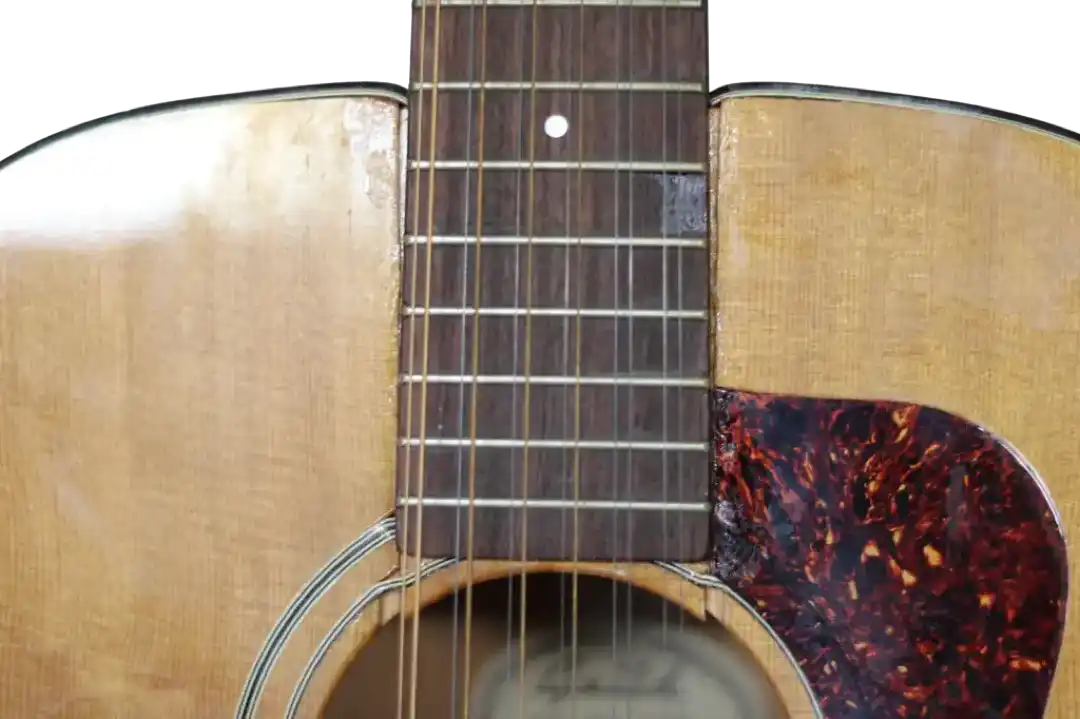
It's all about Flexion
Repeatedly subjecting an acoustic guitar body to flexion will most likely result in damage, ranging from finish cracks to collapse. Allowing the neck block (along with whatever is attached to it) to rotate (even slightly, even temporarily) shifts it away from its originally installed position.
A process ensues which typically results in raised action, necessitating a major surgical procedure known as a neck reset to be performed in order to maintain playability. Left unresolved, neck block rotation/upper bout flexion, in addition to its potential for playing a contributing role in bellying, will lead to tuning instability, cracks, splits and structural failure.
A neck reset is a major invasive operation to correct a damaged condition. Though it may be performed elegantly, by some practitioners on some guitars, this does not lessen the significance of the damaged condition that necessitated it. Just because it is common, this does (should) not make it acceptable.
Whether the neck block has actually come loose from its glued-in position to the sides, back and soundboard via adhesive slip or wood failure, or the entire upper bout has rotated (flexed, compressed, contorted, deformed), either temporarily or permanently, is immaterial.
The neck block should be prevented from shifting out of position relative to the bridge/saddle and the tailblock. It should remain precisely where it was originally installed over the life of the guitar.
Because it was BUILT that Way
Constructing a shell by gluing two bent sides to a neck and tail block, adding kerfing around the inside edges of the sides, gluing on a braced front plate having a hole in it along with a braced back plate, binding the resultant "box", applying a finish, adding a bridge, attaching a neck with a fretted board, and calling the whole thing a steel string acoustic guitar has worked for nearly a century. Countless guitars have been built this way.
More accurately, here is what has actually worked: This process has allowed builders to deliver functional guitars. Safeguarded, and under perfect environmental conditions, many of them have remained as they were built.
However, over time, a weakness in the design has been repeatedly demonstrated, being exploited by string tension in one guitar after another, much to the chagrin of the owners of the instruments. At issue is the ultra-flexible shell, or frame, of the modern acoustic steel string guitar.
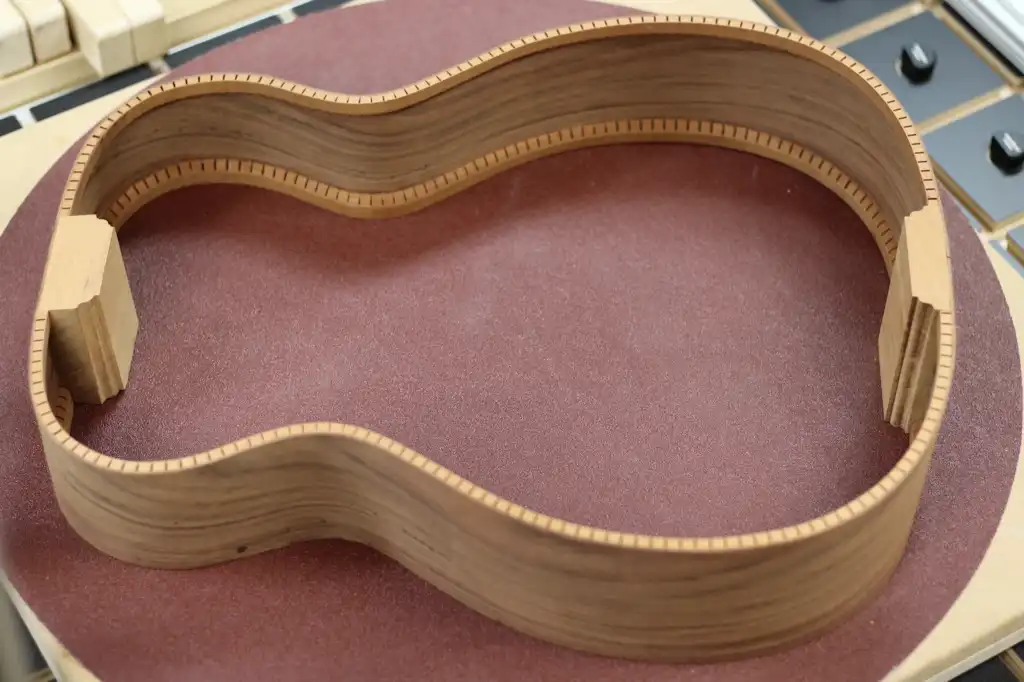
A neck block is constructed to be (relatively) perpendicular to and a fixed distance from the bridge/saddle, as well as parallel to and a fixed distance from the tailblock. Whether the neck block has actually come loose from its glued-in position to the sides, back and soundboard via adhesive slip or wood failure, or the entire upper bout has rotated (flexed, compressed, contorted, deformed), either temporarily or permanently, is immaterial.
The point is: A neck block should be prevented from shifting out of position relative to the bridge/saddle and the tailblock. It should remain where it was originally installed over the life of the guitar.
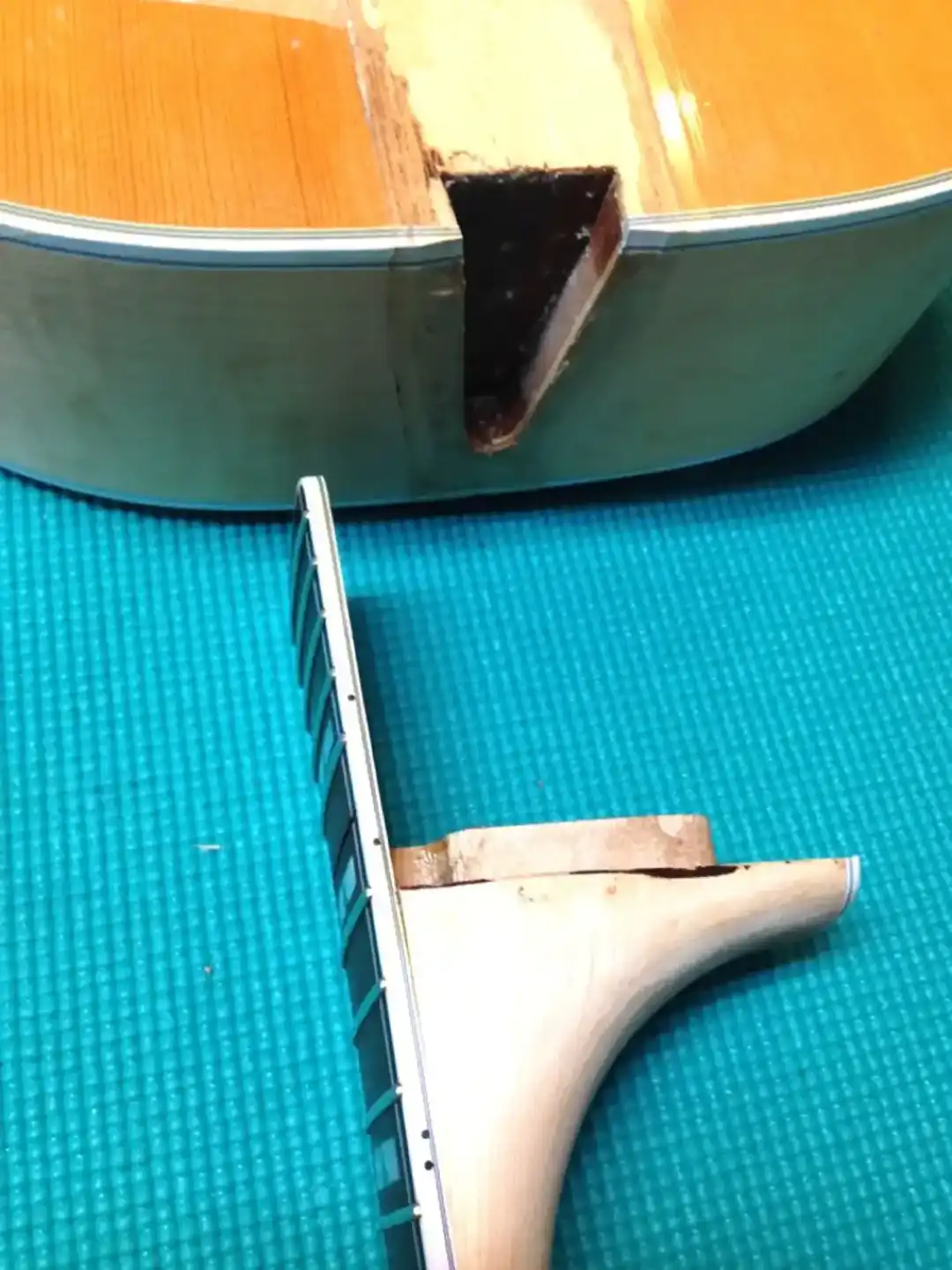
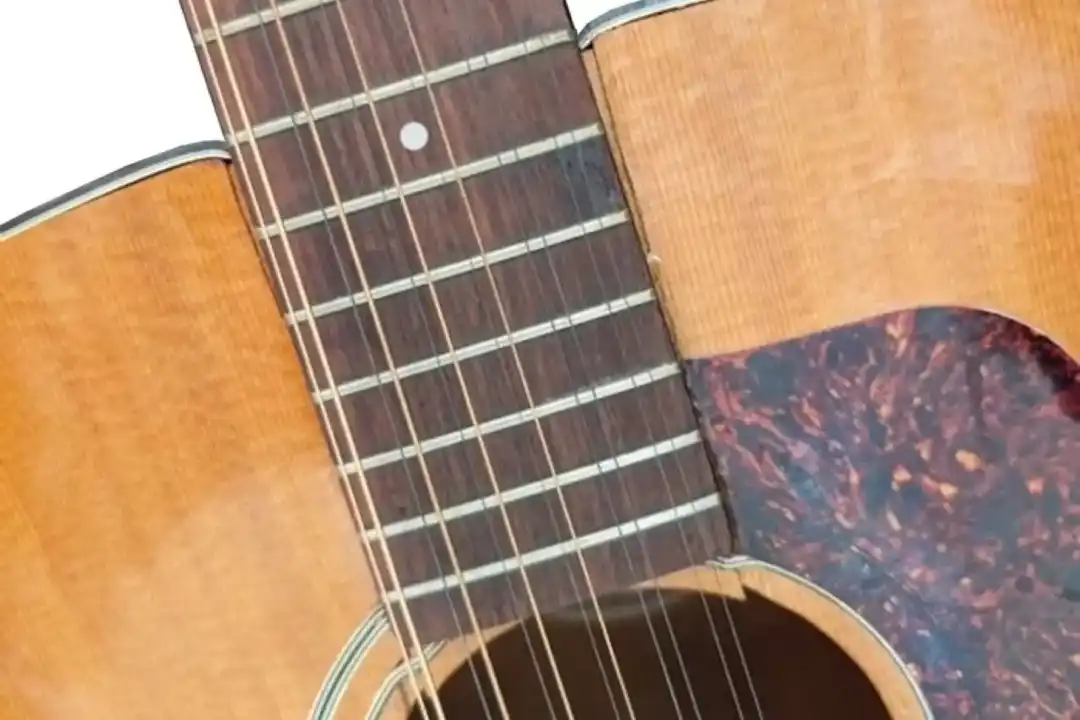
In the photo, above, an all-too-common failure has occurred: The neck block has shifted away from its originally installed position. As a direct result of that shifting, the soundboard has literally sheared off into the soundhole.
This guitar is severely damaged. A couple of cleats, a little glue, a neck reset and some lacquer touch-up may be all you want to invest in such a guitar, but it will not address the issues that permitted the damage to occur.
Simply Too Flexible
Permitting the body to flex, intentionally or not, subjects the soundboard to unwarranted stress. While many guitars will survive the ordeal (at least, for a period of time), most will suffer some form of damage ranging from requiring a neck reset to needing to be rebuilt. Though it may be common, such damage to your guitar should not be considered normal.
It is just a matter of time before a given traditionally-built acoustic guitar will require a neck reset. I consider this to be the result of damage, not some positive form of "readjustment", or "stress relief", or "settling in", or "opening up". Obviously, some guitars hold out longer than others, with a few even seemingly defying my sweeping generalization.
For example, I have owned a Japanese hand-built 12-string since 1978 that has accompanied me multiple times from sea level to 40,000 feet, from 7% RH to 100% RH, across continents, in public squares, parks, cantinas, bars, lounges, churches, cathedrals, amphitheaters, stadiums, and I'm sure I'm forgetting some significant other location, all without a single crack or split. Granted, I would not consider it to be a particularly responsive guitar by today's standards.
So, yes, of course I acknowledge that there are exceptions. And should you be in possession of one or two of them, I am truly happy for you. This article is addressing all the rest of the guitars out there.
Lest anyone think I am recommending building concrete blocks that sound terrible, all in an effort to avoid a neck reset, permit me to state that I know it is entirely possible to construct a so-called "responsive", great-sounding, steel string acoustic guitar that does not require a neck reset. But doing so requires denying the neck block permission to move, and that means re-thinking the design, going back to the beginning, starting from the start.
If you would like to read more about my understanding surrounding the topic of neck resets, see my article titled » The Infamous Guild Neck Reset.
Neck Block Movement
The wooden necks on most steel string acoustic guitars have the capacity to bow forward sufficiently under string tension to significantly raise the action (string height above the frets). Truss rods (and/or stiffeners) have been employed for a little more than a century to mitigate this potential, maintaining the fretboard in a relatively flat plane (if you care to read it, I have written an in-depth article on this feature titled » The Truss Rod).
When guitars having a flat fretboard continued to suffer raised actions, saddles were lowered. When guitars having a flat fretboard, whose saddles could be lowered no further, continued to suffer raised actions, more drastic measure were taken, including the addition of taller fret wire and/or shimmed fretboards. In an effort to stave off the inevitable, some of these instruments had their bridges planed (shaved), in order to prevent the strings from making contact, as the saddles were lowered even further. When all options had been exhausted, only one recourse remained: the neck reset.
We got good at performing neck resets. And we got good at empathizing with and consoling our fellow guitarists who were in the same predicament, many of whom were (rightly) horrified at the prospect of such major intervention. What we did not get good at was solving the problem. We did not expose the underlying, root cause of this deformity. We just got better at calling it "normal". And we came up with some silly, and some seriously wrong, notions of what was behind the need for neck resets.
I fell down some of these rabbit holes. Misunderstanding structure, I altered (and altered, and altered) bracing. Fearing tension, I switched to lighter and lighter string gauges. Blaming climate, I went "mental" for awhile over humidity control. Assuming the worst about the neck-to-body joint, I began affixing necks to bodies in an immovable union using epoxy.
I still happen to use epoxy in my guitars, proudly, and I still control both my build and storage climates, and I like having choices over string gauges, and I really love experimenting with bracing. But I do all of these things for entirely different reasons - and I am getting way ahead of this story.
I started disassembling damaged guitars. I was literally taking them apart, piece by piece, in order to find out what was responsible for the damage. The theories, myths and fables of guitar construction I had long subscribed to began to dissolve before my very eyes.
I consistently discovered necks still securely attached to neck blocks. The preponderance of that evidence destroyed the notion of poorly-implemented or failed neck joints as being the primary culprit.
Experiments with moisture content, in conjunction with string tension tests and physical stress tests, all led me to conclude that the primary factor contributing to the damaged condition that would require a neck reset to repair was the design, itself. More specifically, it was primarily the permission granted to the neck block to move, post construction.
... the primary factor contributing to the damaged condition that would require a neck reset to repair was the design, itself.
There are two forms of neck block movement that may occur. A neck block may actually move independent of one or more the components attached to it, relocating a short distance away from where it was originally positioned. This is not desirable, nor is it just another one of those things that we need to live with. It is called damage.
The neck block can slip out of position, where a glue bond has weakened as the result of some combination of choice of adhesive, insufficient adhesive, and/or exposure to undue heat and/or moisture. If the instrument is removed from the environmental conditions that permitted the damage, the neck block glue bond may even re-set.
For example, when heat is involved (such as when an instrument is left in a hot car, or during a classic dovetail joint neck reset, where surrounding components that are already under tension are subjected to glue-softening conditions), the neck block glue bond is often re-established as the glue cools, but the neck block is now in a new location (relative to where it was originally installed).
With or without a glue bond failure, wood may stretch, tear, or shear away in part or completely due to overt stress. This is often witnessed as the result of a sudden and forceful change, such as dropping an instrument, knocking it over, backing over it in the driveway, swinging it into the drum set or mic stand during rehearsals, lending it to your cousin, etc.
Unquestioningly, neck block movement (and accompanying damage) may also occur as a result of unseasoned wood taking on and releasing moisture when exposed to dramatic humidity changes. But even in guitars having properly seasoned wood, we often witness the entirety of the upper bout flexing, either temporarily due to some unfortunate incident, or continuously while being played, due to its intrinsic and overly-flexible design. This movement, this body flexion, has been largely ignored.
For example, there is a popular vibrato technique used on the acoustic guitar that involves pressing the upper bout tightly against the body while rapidly forcing the headstock end of the neck forward and back. If you believe that this movement is isolated, occurring only in the neck (the same neck you assumed to be stabilized by the use of a truss rod), you are gravely mistaken.
With the image of my damaged 12-string still fresh in your mind, imagine holding that guitar tightly up against your body, and rapidly bowing the neck forward and back. Just for fun, have someone else do it in front of you, and you watch that section of soundboard move in and out of the soundhole, independent of the rest of the top.
Over time, such flexing has a deleterious effect upon the structural integrity of the guitar. The lever action of the neck induces a forward rotation potential (torque) at the neck block, depressing the upper bout, and compressing the soundboard toward the soundhole. On guitars having bridges into/onto which the strings are anchored (aka, most guitars) the lever action of the strings across the crest of the saddle induces a forward rotation potential (torque) at the bridge, pulling the lower bout upward, while depressing the soundboard in front of it, and pushing it toward the soundhole.
The neck is trying to rotate toward the bridge, and the bridge is trying to rotate toward the neck. Between them, there is a giant, gaping hole in the plate that is holding them apart. What could possibly go wrong?
Potential results of body flexion
Permitting movement where movement should not occur leads to deformation and severe damage
Body Flexion FAQ
I am genuinely happy for you! And I have a number of guitars that this has absolutely happened to. And I have had the privilege of repairing countless more.
Yes, though, beyond the obvious matter of affordability, it is important to understand what, exactly, failed. And why it failed. And what, exactly, can be done to prevent it from occurring again. Please read the balance of my article.
Yes, with internal modification. Short of that, if you never string up your guitar you will never see such damage. Please read the balance of my article.
Construction Primer
The body shell of most steel string acoustic guitars is comprised of two bent (or formed) sides glued to a neck block and a tail block. Kerfing (or Peones, Dentallones, Tentalones, Dentil blocks, or solid lining) commonly forms a small ledge at the front and back interior edges of those sides to which the front plate (soundboard) and back plate may be glued. You can read more about these components in my article titled » Neck Blocks, Tail Blocks and Linings.
When building a traditional acoustic guitar body, an intentional balance is reached between lightness of construction and sufficient strength to resist an implosion that would otherwise occur as a direct result of the tremendous pull of the steel strings. Incorporating high quality materials into too heavy of a build can result in a rather lifeless-sounding instrument. Likewise, building a very fragile guitar, regardless of the quality of the components, may result in something that initially sounds delightful, but has a very short lifespan.
The popular combination of bent, solid hardwood sides, hardwood end blocks and kerfed linings that form the body shell of some of our favorite acoustic guitars is impressively non-rigid. Stand such a shell it on its tail (having no soundboard or back plate attached, yet), apply the slightest weight to the neck block end and watch the shell flex while listening to the horrible cracking sounds it makes. Such a flexible shell relies solely on the addition of the front and back plates to form a more stable box.
That "more stable box", or body of the guitar, is not as rigid as one might think. This is evidenced by the number of instruments that suffer damage (which unfortunately, is most all of them, at some point).
Neck Block Shift
The neck of most steel string acoustic guitars, typically constructed independent of the body, is either glued to, or bolted onto, the neck block.
Hidden from view, the neck block may be the single-most critical component of the acoustic guitar. It may be likened to the cornerstone of the building, or the hub of the spoked wheel. It is the structural intersection of the back, sides, soundboard and neck.
The primary force acting upon the neck block is the result of the constant pull of the strings. One end of the strings is (typically) anchored to a bridge which is glued to the soundboard. The other end of each string is secured to a tuning machine head which, in turn, is secured to the headstock at the end of the neck. At a point that is approximately halfway between the two secured ends of the string, the neck is attached to the neck block.
The traditional method of attaching a neck that has been constructed independently from the body employs a woodworking joint known as a compound dovetail. Alternatively, a straight, integral tenon may be glued, or even bolted into a mating mortise in the neck block, or a butt joint (no integral tenon) may be used in conjunction with dowels, or loose tenons.
Regardless of the neck attachment method, the neck block (and everything attached to it) may suddenly rotate forward in response to a sudden change in load and/or a sudden failure in structural support. In the worst-case scenario, the soundboard will split along one or both sides of the fretboard extension, and literally shear off into the soundhole.
Stop to consider that, on all center soundhole, X-braced guitars, there is nothing in front of the fretboard extension except ≈ 12.5 square inches (319 sq mm) of missing soundboard! It is into the abyss of the soundhole that the neck block, the neck attached to the neck block (including the fretboard), and the section of the soundboard glued to the neck block all seemingly seek to plunge.
After a sudden shift forward of the neck block, in less dramatic cases, there may be a spring back to the original position which may, in turn, leave little visual evidence of the trauma. If such a shift has caused a split in the soundboard (or two splits, one on either side of the fretboard extension), this may or may not be immediately, visually apparent, depending on the severity of the shift.
NOTE: If you have ever wondered why you cannot keep a given guitar in tune, one that should stay in tune (as every other possible reason has been eliminated), look (diligently) for a split in the soundboard along the fretboard extension. How does soundboard shear contribute to tuning instability? As you tighten the strings, the headstock, neck, fretboard, neck block, and soundboard all shift in toward the soundhole. It is quite impressive to come to terms with how little is preventing this from occurring.
In addition to a crack in the wood, there may be a visible mis-alignment at the soundhole, as you can clearly see in the photos, below. Sometimes such splits are not readily noticeable and other times there is such significant forward movement that not only is the soundboard jutting out into the soundhole, but the neck has moved forward into the body, curling the binding in with it. Using the tuning machine heads, you can tighten and loosen the strings and watch the deformation occur in real time.
I used my own 12-string as a dramatic example of this problem, but the problem does not requite 12 strings. Severe damage, such as you see in the photos, below, of three 6-string guitars, are classic examples of sudden, catastrophic failure.



We have seen neck block shifts and soundboard shears occurring on large as well as medium-sized guitars, on both 12 string and 6 string instruments. But what about small-bodied guitars? Surely, they are immune to this kind of damage, right?
On the parlor-esque guitar shown in the photo below, a Guild F-20 from the 1980s, everything appears intact: the fretboard is still attached to the neck and the fretboard extension is still glued down to the soundboard, the neck is still attached to the body, even the pickguard is still right where it was originally attached.
But the damage has been done on this small instrument that features a lower bout width of a mere 13-3/4 inches (That's just a fraction of an inch wider than a Martin 0-18). The soundboard has split along the grain, shearing off and plunging forward into the soundhole.

What if there is no splitting of the soundboard? Does that mean that everything is fine? Look at this next example of a 12-string guitar which does not have any visible splits or cracks along the fretboard extension, at least, not yet. In the photo, below, look at the stress fractures in the finish emanating from the neck heel/body joint out across the soundboard on each side of the upper bout. It is just a matter of time ...

Below is a second photo of that same guitar, taken some time, later. Note the buckling/collapsing of the soundboard (beneath the fretboard extension) into the soundhole as a direct result of the forward shifting of the neck. Most importantly, do you see the split at the edge of the soundhole, directly in front of the fretboard extension (it is located slightly to the left of the center of the photo)? I hate to say it, but, "I told ya so!"
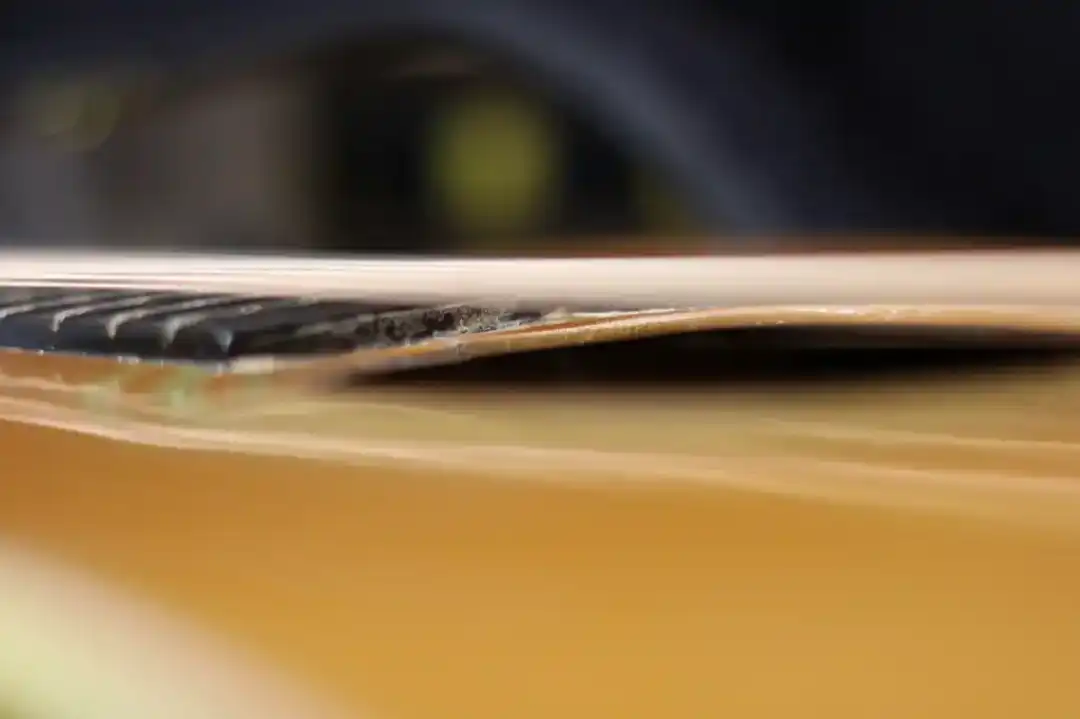
Guitars built using the "Spanish Heel" construction method can still suffer from a forward shifting neck, even though there may be no formal (separate) neck block. To illustrate this, here are photos of a 2021 Turkowiak guitar built this way, having no center soundhole.
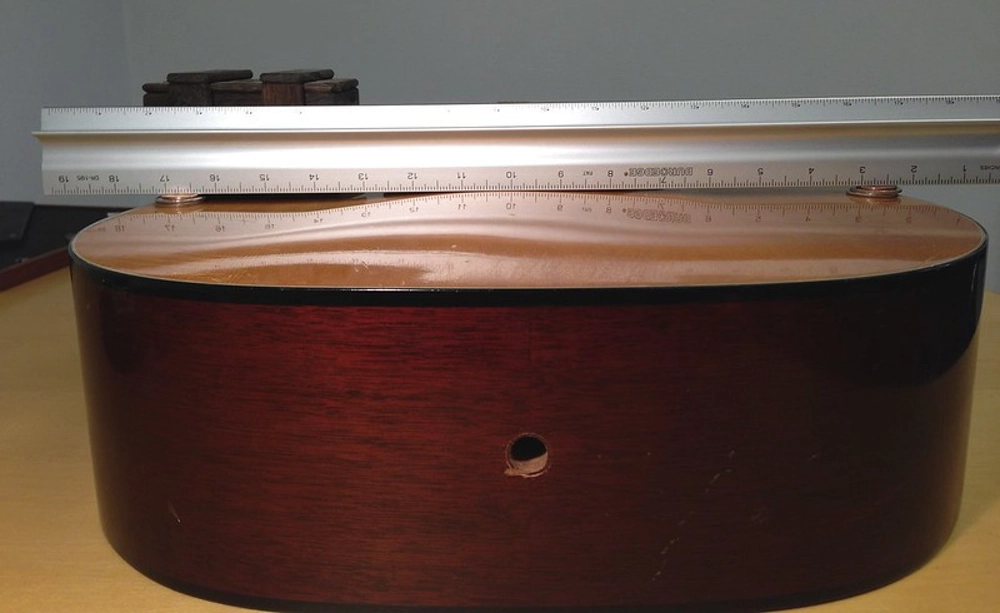
Look at the "crease" across the upper bout, at the end of the fretboard, running perpendicular to the string path.


There is tremendous tension applied to the structure of the steel string guitar. We know that a chain is only as strong as its weakest link. A similar understanding must be held for the structure of the acoustic guitar. If there is a weakness, longitudinally, between the headstock and the tail block, given the opportunity, it will be exploited under string tension.
On this particular 12-string (shown above), the weakest point was to be found in a section of the soundboard directly in front of the fretboard extension (the same place a soundhole would begin on an X-braced guitar). You can clearly see the crease where the soundboard has compressed and buckled under the tension, permitting the neck to shift forward.
Consequently, with the saddle being as low as it can go (already buried in the slot), the action is very high. Since the guitar has been built using Spanish Heel construction, and the components are assembled with epoxy, a neck reset is not viable, as confirmed by the builder.
At the time of this writing, this otherwise very lovely guitar is barely 2 years old. Short of planing (and/or replacing) the fretboard in an attempt to compensate for the deformation, this guitar is already, sadly, at "end-of-life."
Flexion Damage FAQ
Assuming the guitar was originally delivered having proper neck geometry and assuming the neck is not curled forward and assuming the soundboard is not "bellied" due to forward bridge rotation, then yes, neck block rotation/upper bout movement is likely your culprit.
Yes. Most often there is a sudden, temporary shift where the components stay glued together and the soundboard shears under the compressive force of a forward rotation of the upper bout. The upper bout springs back to a position close to original and the only visible evidence of the event is a hairline crack at the soundhole. And tuning instability. And raised action.
Damage has occurred. Depending on the severity, you will likely experience tuning instability and raised action height issues due to the increased movement potential of the neck block.
That is a popular "repair" exercise. Up until the split occurred, forward rotation of the neck block was resisted by the strength (along the grain) of the soundboard, alone. That integrity is now gone, in spite of the presence of the upper transverse brace AND the upper transverse graft ("popsicle" brace) AS WELL AS any additional upper bout bracing. Do you believe a little wooden patch glued to the underside of the soundboard has somehow "stabilized" anything and will restore sufficient integrity to properly resist 175 lbs. of string tension?
Yes. Eliminate the potential for the neck block to shift. This will require internal modification. Read the rest of the article to gain more understanding. Whether you want to make the investment in your damaged guitar, or not, is up to you.
You are free to repeat the process by purchasing yet another guitar that has been constructed in exactly the same manner as all the others you have played and owned, and just "hope for the best". Many guitar owners have been able to enjoy the best years of a guitar's life prior to submitting the instrument to the "Used Guitar" market, without experiencing significant damage. When shopping for one of these used guitars, be aware of what you might be getting yourself into.
Shift Happens
My hope is that others will also gain an understanding of what I believe to be a common design failure, a mistake that can be corrected, preventing this catastrophic mishap.
There is far too much movement potential in the design of many (most?) acoustic guitar upper bouts. The Guilds, Martins, and Gibsons I have shown photos of in this brief article, along with loads of other makes and models, have all shared this design flaw at one time or another and are prime targets for this catastrophe.
A sudden change, such as a guitar falling over or out of a stand, or being pulled out of a tight-fitting case by grabbing the neck and yanking it free, or even by being dropped while still in its case, may be enough force to shift the neck block forward and split or shear the soundboard. Then again, as we can observe in the photos of the 12-string (shown at the outset of this article), a guitar may sit in its case, strung to pitch and be undisturbed for years, and a shift can occur.
NOTE: It is important to realize that we are talking about extremely small measurements of movement, but dismiss this "tiny" amount of movement at your (or your guitar's) peril!
Do you still cling to the notion that your guitar is simply "opening up" as it readjusts and realigns itself? Do you think that needing a neck reset is just evidence of your guitar relieving itself of all that unwanted stress due to string tension? Do you prefer to ignore the damage that has occurred/is occurring to your guitar, calling it a good thing?
Would you rather pretend that the examples I am providing here are rare events from distant lands and could never happen to you and your beloved instrument(s)? Or, even worse, would you insist that any efforts to overcome such a design weakness would leave your guitar sounding like a rubber band stretched across a 2 x 4?
As the Gatekeepers of the Status Quo like to remind me, "We all know that if there were any significant improvements to be made to the design of the acoustic guitar, they would have already been made long ago!"
I beg to differ. While there are many beautiful and great sounding guitars that have been, are being, and will be built, I do not accept that we are at the pinnacle of acoustic guitar design. If that is indeed true, the "guitar industry" may be the ONLY industry without an ongoing Research and Development department. Were you aware that tire companies have research and development staff dedicated to the topic of tread design? That's crazy, right? I mean, weren't tire treads perfected ages ago? And what about golf clubs? And running shoes? And pots & pans? {sigh}
The New Normal
Imagine your reaction if the wheels on your car were to suddenly fall off after {n} number of miles. I am truly happy for you if neither you nor anyone else is injured or worse, and thrilled if you have a current Roadside Assistance program and can get back on the road with little interruption to your plans. But, just in case you were never informed, wheels are not supposed to fall off cars!
Would you be surprised if the Service Manager at your favorite auto dealer informed you that a "truck bed reset" was recommended for your favorite pickup truck? This would involve removing, adjusting and then re-attaching the bed of your pickup, putting it back where it was originally installed, and you would need to leave the truck with them for a few days. If you expressed any dismay, they could reassure you that such a maintenance task is to be expected as your truck "opens up".
What if you were told that your house is just "opening up" and "settling in" and "relieving stress" as it slides off its foundation, or its roof suddenly collapses?
Stop lowering the standard! Acoustic guitar neck blocks are not supposed to shift, and their soundboards are not supposed to crease, collapse, split or shear! Instead of excusing it, we can simply and honestly call it what it is: Damage. And we can acknowledge the most likely cause of that damage, which brings us right back to the design and construction of the instrument.
Mitigation Attempts
Once upon a time, a little over one hundred (100) years ago, guitars suffered an even more dramatic fate than neck block shift and soundboard shear. It was known as a buckling and collapse! When the first steel string instruments began circulating, replacing their cat gut string siblings, builders and players alike were able to share in a new experience where guitars collapsed, literally imploding under the profound increase in string tension. They effectually folded in half upon themselves like a wooden beam buckling under a heavy load.
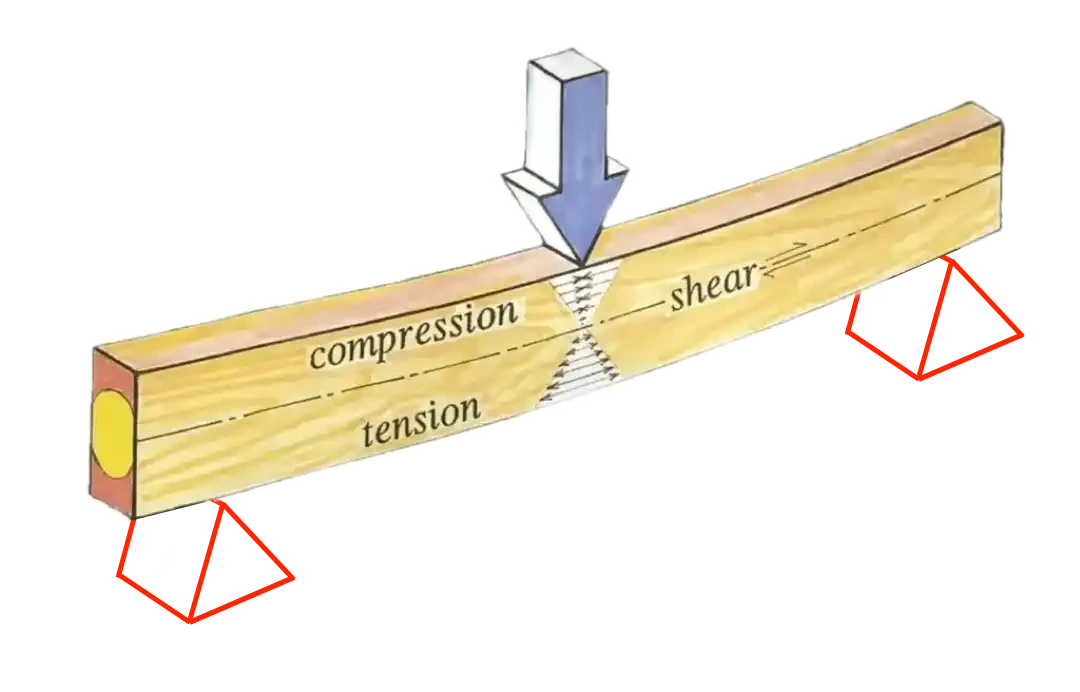
Long, long ago, in a shop far, far away, a lone luthier looked down upon the wreckage of one of these imploded guitars and thought, "Maybe if I glue this monster brace across the upper bout section of the soundboard, that'll fix everything." And the transverse brace (upper face brace) was invented, just like that. At least, that is how I like to imagine it was invented.

Word spread and soon luthiers throughout the land were incorporating the transverse brace into their own guitar builds, thinking to themselves, "What a great idea." And it was a great idea. With more wood being glued to the backside of the soundboard, fewer guitars were completely collapsing and folding in half than ever before. Some even thought that if one transverse brace is good, two has to be better (see below)! And the people were happy.
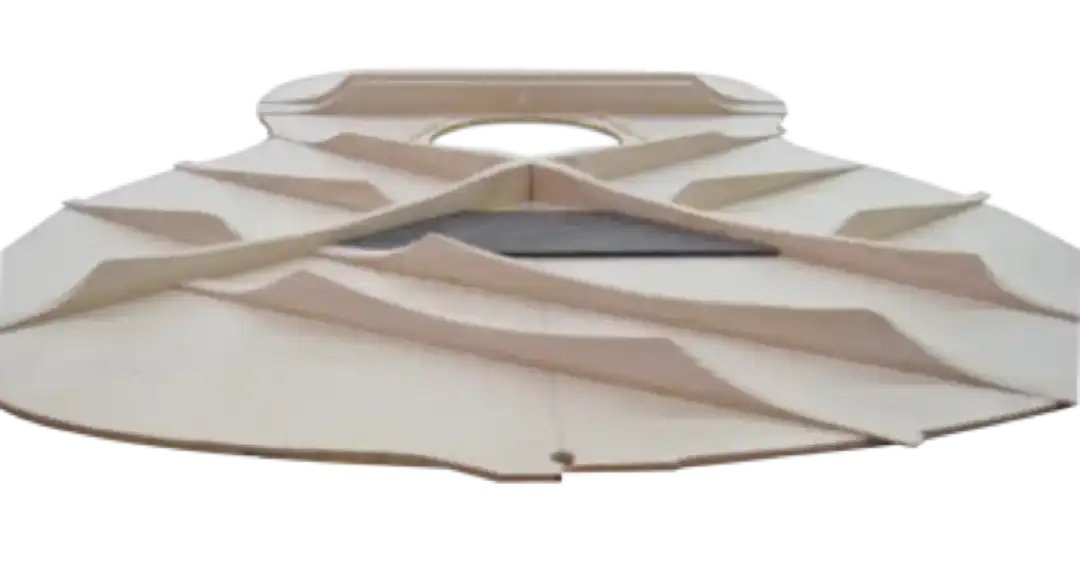
The idea behind the use of the transverse brace that runs from side to side across the upper bout, just above the soundhole, is that if sufficient support is provided, the fretboard extension (and the soundboard beneath it) won't plough downward into the body under string tension.
While the transverse brace may have prevented some instruments from imploding, it certainly didn't stop neck blocks from shifting. And it didn't stop soundboards from shearing.
Less long ago than the first long, long ago, and in a shop a little bit closer than the shop that was far, far away, a lone luthier looked down upon the carnage of a soundboard sheared off deep into the soundhole and thought, "Maybe if I glue this little strip of wood across the upper bout section of the soundboard, in the only space left between the transverse brace and the neck block, that'll fix everything." And the upper transverse graft, or "popsicle brace" was invented, just like that. At least, that is how I like to imagine it was invented.
Others went and did likewise, thinking to themselves, "What a great idea." And it was a great idea, because it was fun to say "upper transverse graft," and maybe even more fun later to say, "popsicle brace". More importantly, it didn't stop neck blocks from shifting. And it didn't stop soundboards from shearing. But hey, just be happy your guitar didn't fold in half!
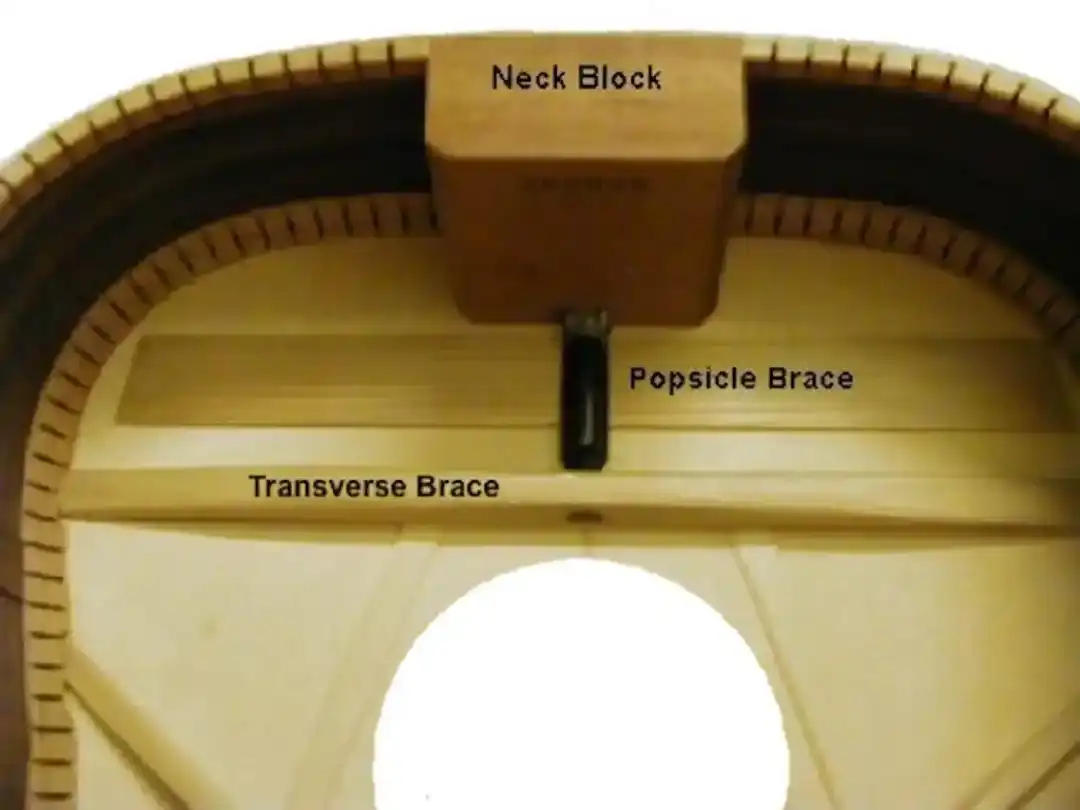
And so guitar makers everywhere added the transverse brace and popsicle brace to their designs and everyone everywhere could now purchase guitars with these new innovative features. And neck blocks still shifted. And soundboards still sheared. But guitars stopped folding in half.
And the people were happy.
And a guitar maker here, and a guitar maker there apparently grew concerned about the fact that soundboards continued to shear, because strange additional braces began to appear in the upper bout area. The area that once was occupied by the transverse brace alone, was now occupied by the transverse brace, the popsicle brace and additional braces.
The Wing Grafts
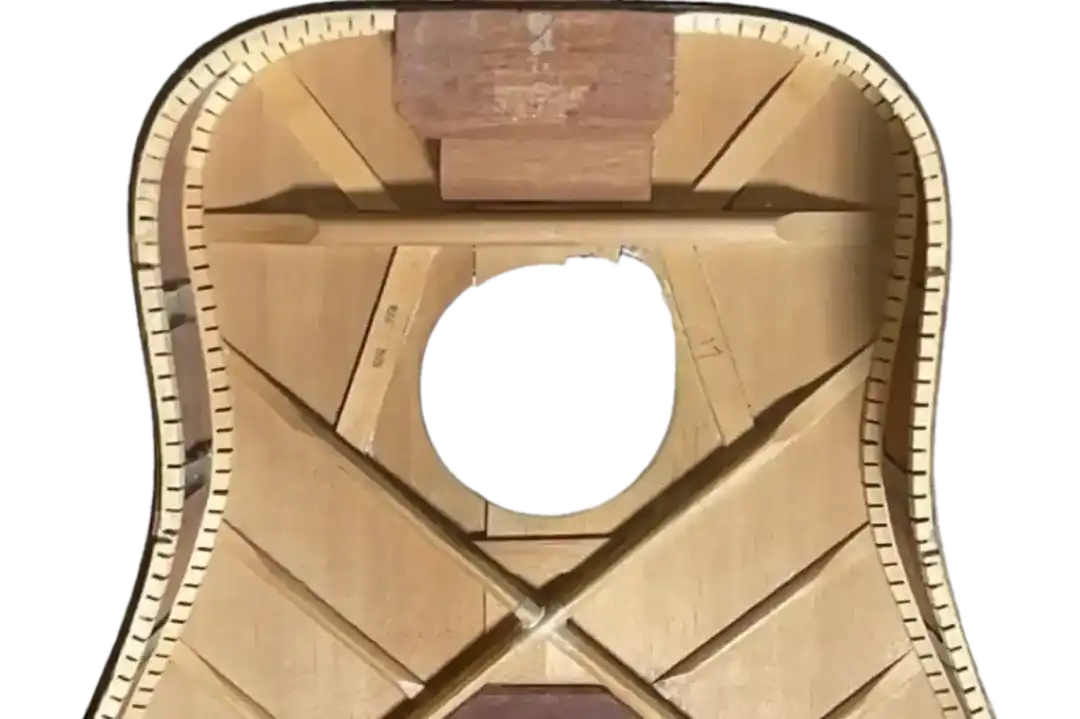
Let's Talk Guild forum member GardMan has pointed out that sometime around the Summer of 1974, Guild guitar makers added two "wing" grafts, popsicle-style, to the otherwise unoccupied area of the underside of the soundboard in the upper bout. More braces. The idea caught on. Depending on make, model, and manufacturer, these patches range in size, from a healthy 3/4" width down to a paltry 3/8" wide.
The Guild braces, in particular, all ran diagonally from the transverse brace near the neck block out toward the centers of the shoulders of the upper bout, resembling outstretched arms or wings (hence the moniker: "wing" brace). It is interesting to note that when a soundboard shears along the fretboard extension in one of these guitars, it always happens between the edges of the fretboard extension and the ends of these diagonal brace(s).
Their positioning/placement begs the question: If sufficient force and/or inertia applied to the neck block/upper bout area were to telegraph along these braces and be concentrated at the soundhole, would this not contribute to a shearing of the soundboard along on or both sides of the fretboard, instead of preventing it? Regardless, any positive contribution of the wing grafts is questionable, at best. But one thing is clear: they are utterly useless at stopping a soundboard shear, as the photo below clearly demonstrates.
The Neck Block Extension
During that same Summer of 1974 and the addition of the wing grafts, another design decision was made at Guild. It was decided that adding a small block of wood to the top front of the neck block on 12-string models, forming a ledge or shelf at the soundboard, and purposefully extending the neck block would be a good idea.
In theory, this would add more real estate to glue the soundboard to, well above and beyond what you would expect to find in the traditional 6-string guitar neck block. The extra buttressing would potentially aid in the tendency of the fretboard extension to want to depress the soundboard, pushing it in toward the back of the guitar, as the cantilever of the neck tries to pivot at the body joint, essentially folding the body in half. Sounds good, right?
Except that it didn't prevent the neck block from shifting and the soundboard from shearing. Like the transverse brace, the popsicle brace, and the wing grafts that preceded it, the neck block extension is based entirely upon a false premise, as I will demonstrate in a moment.
At whatever point the neck block suddenly shifted and/or rotated or tilted forward, it simply took the section of the soundboard that was glued to it along for the ride, shearing away from the adjacent wood of the soundboard. This occurred in spite of all that extra buttressing of the additional ledge added to the neck block, or the addition of the wing grafts, or the presence of the popsicle brace, or the support of the transverse brace.
NOTE: You may notice a theme developing.
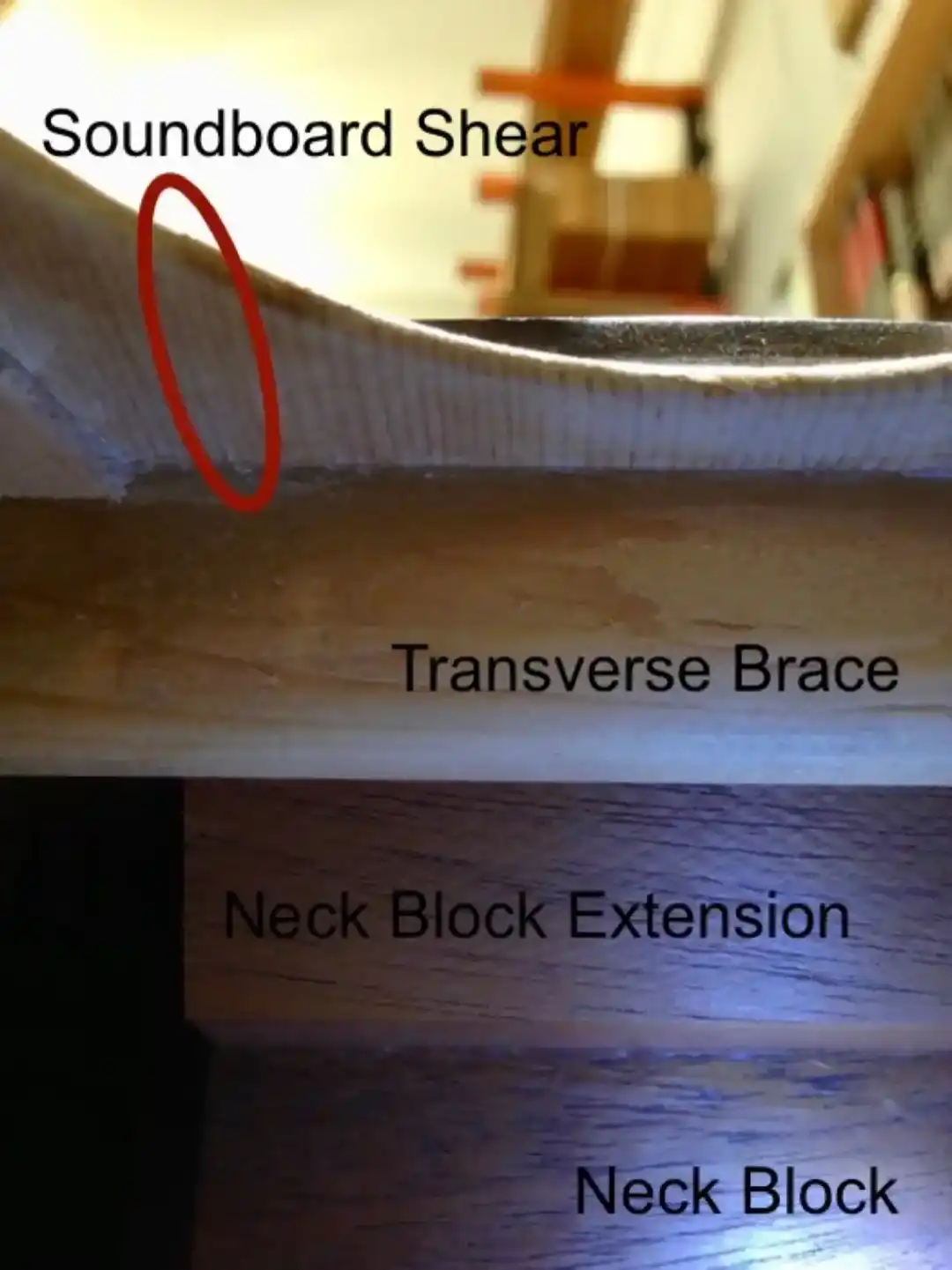
We must also acknowledge the Soundhole Support Plate, or "soundhole patch." Many builders decided to replaced the ubiquitous "3 Sticks" soundhole bracing with a thin veneer than sat between the transverse brace and the X-brace. Such an application is certainly warranted if the reasoning is to support the thin soundboard in the area where the giant hole has been cut. This makes even more sense if you understand how much more soundboard material is removed when large rosettes of shell and plastic or wood purfling are installed.
But I don't believe everyone shared the same reasoning behind the initial introduction of the plate. It was thought that this would help to counter the shift and shear issue. Once again, we have an implementation of a design feature based on a false premise (more on this in a moment), as demonstrated over and over again.

The photo, above, is of one of these soundboard plates or patches still appearing to be perfectly intact. The problem here is that the soundboard has sheared clean through to the soundhole, in spite of the plate! There is an accompanying split that runs along the fretboard extension, ignoring the wing grafts, the upper transverse graft (popsicle brace), the upper transverse brace. The split ignored the soundhole patch, as though it wasn't even present! It would be humorous, if it wasn't so downright tragic!
The A-Frame
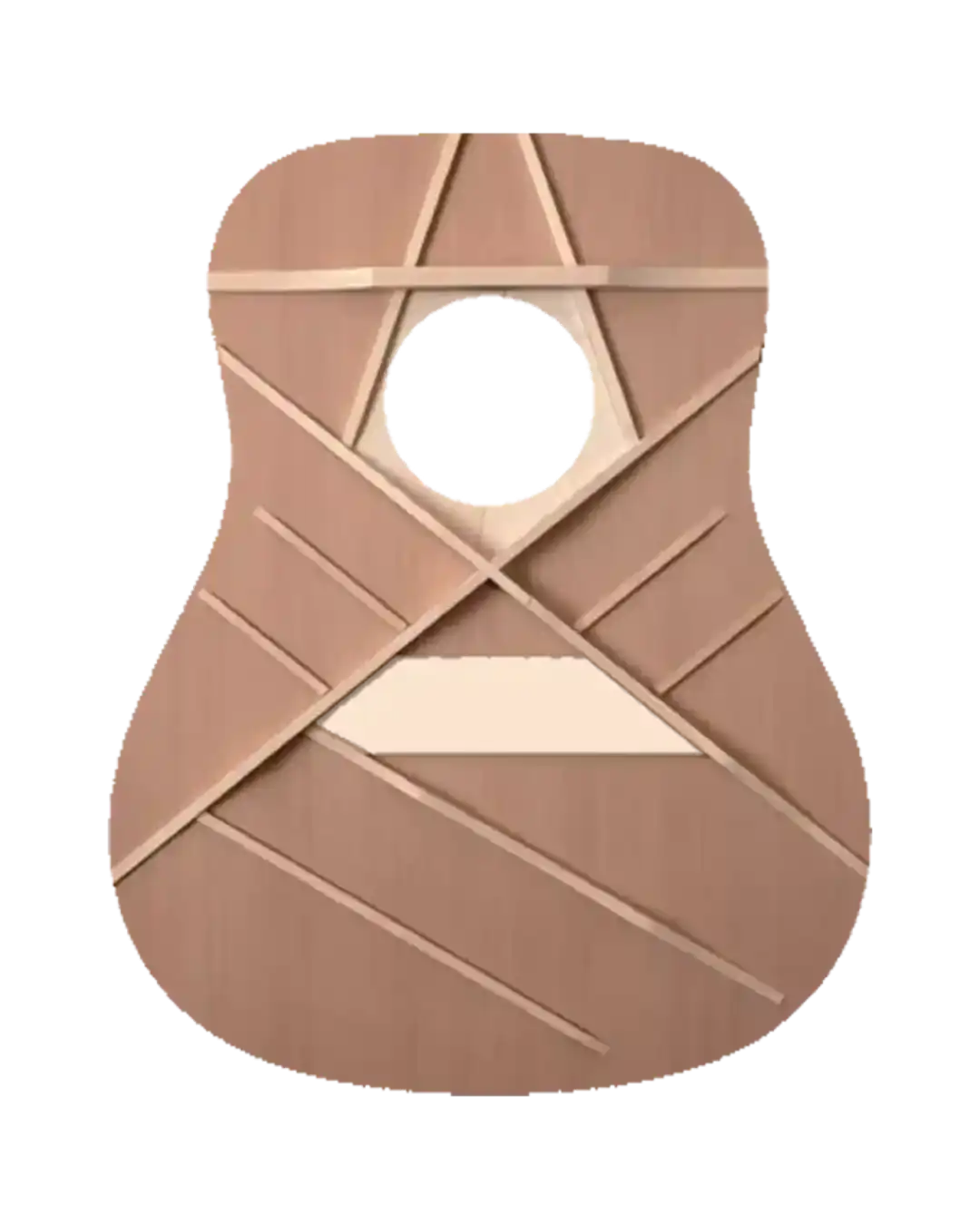
A more recent design that seeks to improve on the popsicle brace/wing grafts combination is seen in the A-Frame (or "A-shaped") brace. Two braces embed into the neck block, beneath the area of the fretboard extension, and splay out alongside the soundhole, terminating into the upper arms of the X-brace. The transverse brace is notched to straddle these two braces, forming the horizontal member of the "A". The soundhole is framed with bracing.
We might assume that the force applied by a shifting neck block could be distributed to some point on the soundboard outside of the soundhole. This approach may very well prevent soundboard shear in all but the most severe cases, and I do think it is definitely an improvement on the "wing graft" approach. However, to be successful, the A-Frame bracing relies on the integrity of the soundboard, forcing the board responsible for sound generation into a structural role. The actual culprit behind our potential for damage, a forward-shifting neck block, remains.
Soundboard Shear
Let's look just a bit deeper into the force(s) at work behind the shearing of the soundboard, using traditional acoustic guitar construction. I am describing components as you would view them if the guitar was laying on its back on a bench in front of you.
Fretboards have been made from very dense hardwoods, such as Ebony or Rosewood. The grain direction of the fretboard runs lengthwise from the headstock, down the neck, and out onto the soundboard. When exposed to moisture variations, a quartersawn fretboard will expand and contract from side-to-side up to 4%, and up and down as much as 8%.
The fretboard extension is glued down to the softwood Spruce or Cedar soundboard beneath it. The grain direction of the soundboard also runs lengthwise and, when exposed to moisture variations, it will expand and contract from side-to-side up to 4%, and up and down as much as 8%.
Note that fretboard and soundboard expansion and contraction will occur in the same direction, however; being different species, at rates that are different from one another.
The soundboard is glued down to the neck block, which is positioned in the guitar such that its grain direction is perpendicular (rotated 90°) to the soundboard and fretboard. The neck block's greatest potential for expansion and contraction is tangential, therefore, because of how it is positioned, movement as much as 8% will occur up and down, from the back of the guitar toward the soundboard, and vice-versa. Where the soundboard is glued to the neck block, the neck block is subject to expansion and contraction radially, up to 4%. See the photo, below.
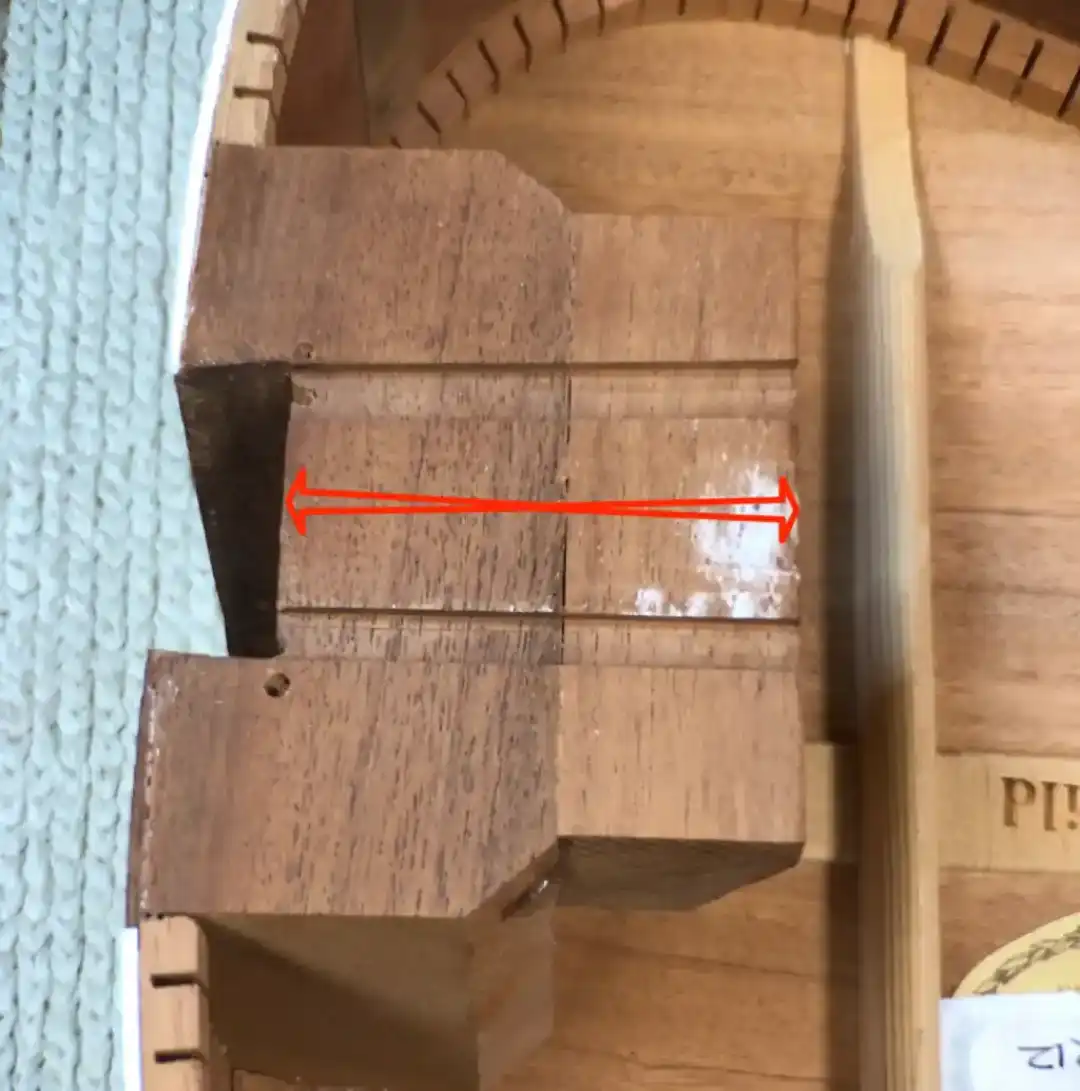
While we are at it, quartersawn sides are also glued to the neck block, having grain direction that is running lengthwise around the body of the guitar. When exposed to moisture variations, a quartersawn guitar side will expand and contract from its side-to-side (radially) < 4% and in and out (tangentially) as much as 8%. Viewed on the guitar, radial movement in the sides will occur from the back of the guitar toward the soundboard, and vice-versa, and tangential movement in the sides will occur from inside the guitar body toward the outside, and vice-versa.
The neck block that those sides are glued to is expanding and contracting tangentially < 8%. Note that there is potential for greater movement in the neck block, up and down, than in the sides glued to it.
In the absence of 165+ pounds of tension pulling the neck in toward the bridge, expansion and contraction in the woods at this critical structural intersection of components would pose no problem. Let your imagination be your guide, and consider what may occur when the moisture content changes, let alone should the guitar be subjected to additional factors like heat and sudden impact.
Identifying the Problem
To begin to understand what is allowing a soundboard to shear on most traditionally built, center soundhole guitars, we need look no further than the soundhole, itself. To put things in perspective: when tightened, guitar strings are quite capable of ripping the bridge off the face of the guitar. A four (4) inch (101.6 mm) diameter hole has been cut into a thin wooden plate in front of that bridge, in a location that, in the case of a 12-string guitar, is supporting (literally, resisting) well over 200 lbs of pressure/tension (in some cases, 250+ lbs).
In relation to the body of a guitar, the neck is viewed as a cantilever. It is affixed to the body at the upper bout. Traditional belief maintains that, on steel string acoustic guitars, the neck joint can act as something of a hinge, allowing the neck/fretboard/fretboard extension to tilt or pivot downward.
This action will result in the concentration of force onto the precise location of the soundboard where 12.5 square inches of very needful support material is now non-existent. A gaping hole resides where that wood used to exist. What could possibly go wrong? The fact that soundboards having no soundholes, or significantly offset soundholes, do not experience shearing along the fretboard extension is clear evidence of the actual problem.
I believe that most of the steps taken to mitigate the neck block shift have focused on the hinge aspect of the cantilever neck that I mentioned, above. It is (wrongly) assumed that the neck is hinging at the surface (soundboard side) of the neck/body joint, and therefore the fretboard extension must be supported by the massive transverse brace, else the neck will fold forward. To help visualize this belief, see my illustration, below.
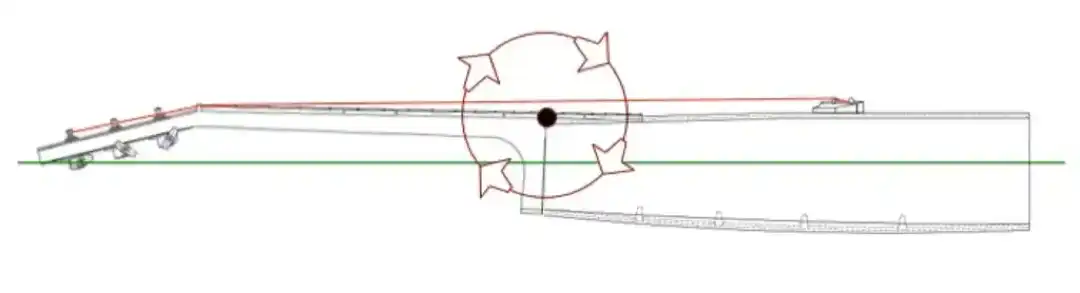
EVIDENCE: Such a hinging action would require the neck joint to have failed, yet all but 1 of the approximately 100 damaged guitars I have encountered has had its neck securely fastened to the neck block. But set that aside for a moment: In spite of all the extra buttressing beneath the fretboard extension (transverse brace, popsicle brace, wing grafts, neck block extension, etc), neck blocks still shift forward, actions still raise, and soundboards still shear.
A body of evidence has piled up around us over the decades, evidence that clearly demonstrates the design of the support of the upper bout of most acoustic guitars is flawed. Believe it or not, the force that is responsible for the neck block shift and soundboard shear is not the hinging motion I am showing in the photo, above.
Let me re-state this: For such a rotation to occur, it would first be necessary for the neck joint to completely fail. In other words, if necks were really hinging at the top edge of the guitar, we would see the heel of the neck lift away from the guitar sides. But that isn't what we see.
WHAT IS REALLY HAPPENING: Understand that the neck (along with the neck block and flexible upper bout) is being pulled forward ⟹ toward the bridge. See my illustration, below:

If any "rotation" is occurring, the entirety of the upper bout, including the neck block, is involved. If we consider the base of the neck block to be that portion that is glued to the back plate, we can more accurately identify the fulcrum of our lever, as shown in the illustration, below.
It is my hope that you are able to better visualize the force(s) working on the soundboard.

Due to a wrong assumption, very little, if any attention has been paid to this fact. Builders everywhere, me included, jumped on the hinging motion bandwagon and never looked back. The first three or four guitars I built had transverse braces and popsicle braces and wing grafts, oh my! I lacked the understanding to see how, by just emulating yesterday's designs, I was doing NOTHING to resist this forward shifting potential.
Stop That Shift!
Stop the shift before it starts. There is a worthy saying: An ounce of prevention is worth a pound of cure. Mitigation efforts have consistently failed due to the (false) assumption that the force to be countered is downward.
NOTE: By the time the downward movement is occurring, or even about to occur, the damage is already done!
The neck has already shifted forward, in toward the body, and it is too late to do anything about it. By understanding that the force to be countered is forward, one can realize the folly of adding more cross-bracing in the upper bout and begin to explore the design changes necessary to stop the shift before it starts.
CLUE: If we prevent the neck from moving forward, it cannot hinge downward!
If we prevent the neck block from shifting forward, the soundboard cannot shear. If we prevent any forward movement on the part of the neck / neck block / upper bout, we never need to reset the neck (unless there is a problem with the bridge/bracing that causes the soundboard to lift, and re-gluing is insufficient to correct the geometry, but that is (or should be) an entirely separate issue).
To better support a center soundhole design, it is necessary to first address the structural integrity of the guitar. A solution lies in reinforcing the body shell (particularly in the area of the upper bout), not the soundboard. Traditionally, by (wrongly) focusing on the hinging potential of the neck, a multitude of unnecessary bracing has been added to the design, which does not prevent the neck block from shifting or soundboards from shearing, as we have seen.
The neck must be prevented from shifting forward. It must be prevented from movement of any kind.
Immobilizing the neck block requires re-thinking its relationship to the entire upper bout; indeed, with the entire body of the guitar. If there is any potential for movement, once conditions are right, movement will occur. If the upper bout can move, it will. I have shown that this can affect any guitar, regardless of soundhole placement.
If a neck remains perfectly flat, with no forward bow, and the guitar develops a high action, what caused it? If the bridge on that guitar has not moved (rotated forward), and if the soundboard on that guitar has not lifted ("bellied"), what is responsible for the high action? In other words, when your guitar needs a neck reset, the predominant reason will be that the neck block has shifted forward, away from its precise location when the guitar was first constructed.
Prevention
Call me "old school", but I am convinced that to effectively prevent a future catastrophe I need to understand the ACTUAL cause of the one in front of me.

When I build a conventional, center-soundhole, X-braced soundboard, I remove what would otherwise be the sole remaining structural support that had a whisper of a chance at resisting the forward movement potential of the neck / neck block into the body. I must do something to restore that support, or I will continue to suffer neck block shifting and potential soundboard shearing. It may take decades for it to appear, but it will appear.
In the case of the sinkhole in the photo, above, support is required beneath the road to support the weight that is pressing downward.
On my guitar, the soundhole is not actually a sinkhole (though it can become one, given the proper circumstances), as the issue is not about weight pressing downward (though that is exactly how it has been treated). Rather, there is a constant lateral force being applied that is sufficient to distort/compress a perfectly round hole into an oval, and that force resides at 321 My Neck Block Lane.
NOTE: This condition is applicable to most all steel string acoustic guitars having a center soundhole.
Using the sinkhole analogy: my car is stopped at the edge of the hole, brakes applied. A big truck has pulled up behind me, bumped into me, shifted into low gear and pressed down on the accelerator pedal.

I am not suggesting this is an issue for Nylon string guitars. The relationship between the forces and components is different. Using my silly truck-car analogy, in an exaggerated comparison, you can reverse the order of the vehicles and visualize the difference.

Rigidification
In my endeavors to eliminate the negative results from neck block movement, I have accepted the need to immobilize, or ri-gid-i-fy, the body shell as much as is reasonably possible, especially at the upper bout. If "ri-gid-i-fi-ca-tion" it is not yet a proper lutherie term (let alone a real word), I propose that it should be.
For maximum rigidity, the sides can be laminated (with or without a vacuum press). Do you recall the (stable) 12-string I mentioned traveling the world with? It has laminated sides. Using a pre-bent solid wood outer layer (the same wood you would have used for a solid side, just thinned a bit more), along with one (1) or more additional inner layer(s), a very stable shell may be formed that can more effectively maintain its shape outside of a body mold.
Laminating hardwood neck and tail blocks stabilizes them against seasonal effects. This can eliminate the "telegraphing" effect of the tail block through the soundboard, as well as put an end to the confusion over the so-called "fretboard hump". For more on this issue, see my article titled » The Fretboard Hump. Some makers successfully use plywood for this purpose. I tend to glue up my own blocks, typically of Mahogany or Spanish Cedar.
Consider re-orienting the laminated neck block, rotating it 90°, such that the grain is running lengthwise and the radial movement (< 4%) is now identical to the soundboard and the fretboard. There is virtually ZERO movement along the grain, so this eliminates any concern about neck block expansion contributing to soundboard shear.
If you are already using laminated sides, kerfed linings are fine (I prefer reverse-kerfed linings for their appearance, and I think they add a bit more rigidity). However, laminating the linings adds even more strength to the body shell. My linings are (typically) made from 3- or 4-ply laminated Spanish Cedar, though I have have used multiple species of wood for this task (even Maple).
SIGNIFICANT DESIGN DISTINCTION: Tying the neck block to the tail block using carbon fiber rods takes the model a step further (and there are many ways to do this). For center soundhole soundboards, it is not advisable to run rods directly from neck to tail, unless you are willing to sacrifice access to the interior via that soundhole. Instead, the rods can be diverted to the waist, such as may be seen in luthier Rick Turner's approach for his Compass Rose guitars.
This is one way I have braced my own center soundhole soundboard guitars (see photo, below). A pair of rods runs from each side of the neck block to a block attached just below the waist. Two additional rods, one on each side, run from the waist to the tailblock. Six rods in total are used to stabilize the neck block.
Eliminating the potential for forward movement of the neck block results in eliminating the need to reset neck geometry caused by neck block shift. Additionally, by eliminating neck block shift, we eliminate the shearing potential of the the soundboard.

Beyond the Center Soundhole
While I still build the occasional center soundhole guitar for the discerning client, I intentionally moved beyond center soundhole guitars for my own designs, joining a growing contingent of luthiers who had chosen to explore the possibilities of "Life beyond the X-brace."
Many instruments that have been built over the last few decades as a result of efforts of pioneering guitar makers such as Charles Kaman with his Adamas models, George Gruhn with his Tacoma models, Tom Bills, Matt McPherson, Cory Batson, (the late) Ken Parker, Rafal Turkowiak, Giuliano Nicoletti, and so many more.
In 2014 I consolidated my design experiments, and settled on my own rendition of an offset soundhole design. I refer to this feature as a Shoulder Port.
More than simply a cutout in the soundboard, the soundhole actually occurs/resides in both the soundboard and the side at the upper bout, hence my usage of the term "shoulder". Its location also doubles as a player soundport, hence my usage of the term "port". It is a bit complicated to construct, but it is both effective and aesthetically pleasing. To the point, by moving the soundhole to the side of the string path, out of the way of the direct force(s) applied along that path, I realized several benefits:
- Structural Support: Re-introducing long-grain wood where a massive hole would otherwise be cut creates the opportunity to further explore the forces acting upon the guitar.
- Good-bye Soundhole Shear: And good riddance. There is nothing to shear.
- Bracing Design: A larger canvas is available upon which to paint a soundscape. Not having to compensate for structural weakness introduced by the soundhole opens a whole new world of bracing possibilities.
Tampering with the traditional location of the soundhole, moving it from its well-established and long-held, sacred position of being centered at the waist, completely ruined the sound of all my guitars!
Just kidding!
The guitars sound great, both to the audiences as well as to the players. It is my hope that more builders will lose their fear of deviating from the status quo, and begin to explore the potentials of the soundboard.
How to Retrofit a Guitar
Can an existing X-braced, center soundhole guitar be retrofitted sufficiently to mitigate or prevent the body flexion that results in damage? Yes, it can!
If you will be replacing (or removing in order to adequately repair) the soundboard of a damaged guitar, you gain unrestricted access to the interior. For undamaged soundboards, if do not wish to go to the additional effort of removing the back, it is possible to work carefully through the soundhole. I would recommend protecting the edge of your soundhole with a piece of clear plastic tubing split lengthwise and carefully fitted in place as a bumper.
If you will be replacing (or removing in order to adequately repair) the soundboard of a damaged guitar, you gain unrestricted access to the interior. For undamaged soundboards, if do not wish to go to the additional effort of removing the back, it is possible to work carefully through the soundhole. I would recommend protecting the edge of your soundhole with a piece of clear plastic tubing split lengthwise and carefully fitted in place as a bumper.
Think about the torque (rotational) potential of the neck block/upper bout and proceed accordingly.
Using hollow tubes or solid rods (I have largely relied on 1/4" (6 mm) solid rods for the task), you can secure a carbon fiber stiffener between the top of the neck block (nearest the soundboard) and into a small block located at a point at the waist (nearest the back plate). One rod on each side will likely be sufficient to mitigate neck block movement. I prefer to use a more paste-like epoxy for such tasks as opposed to a less viscous (watery, or runny) alternative. My favorite epoxies in this category are Superbond by FGCI and Scotch-Weld 2216 by 3M.
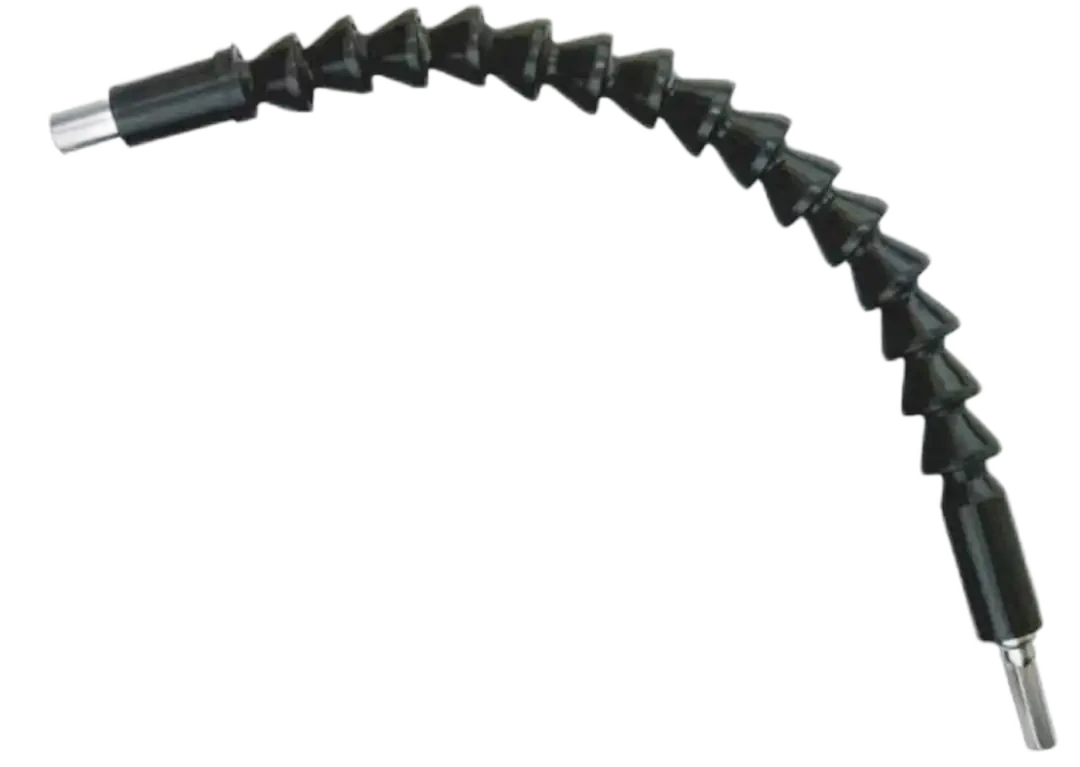
Rather than simply set the end of a rod into a blob of epoxy on the neck block, you may wish to create a shallow recess in the neck block to house the rod. An inexpensive, flexible extension for a hand drill/driver may suffice.
At the waist, you may experience greater success, especially in regards to a clean installation, by first fashioning a small wooden block to receive the opposite end of your rod or tube. This block can also have a shallow recess drilled into it to house the rod/tube, just like the neck block. It is glued against the side at the waist, and pins the rod against the neck block.
For a more comprehensive solution, you may wish to run an additional rod from the waist to the tail block. If you have unrestricted access to the interior, this is very straightforward.
If you were forced to work through the soundhole for neck block rods, "think different" in order to add the tail block rods. Consider drilling through the end graft on the exterior of the instrument for access. Position your hole near the soundboard, as opposed to near the back. The rod(s) can be carefully fitted and neatly epoxied between your newly-added waist blocks and the tail block in this manner.
Fit, mark, and cut the rod(s) short enough to be retained in the tail block without protruding beyond the exterior. Fill the vacancy with epoxy. Taking exterior aesthetics into consideration, you may wish to fit a small plug into the hole, flush with the end graft.
Summary
For makers, consider an alternative approach to relying on the soundboard (and extra bracing) to maintain the structure of your acoustic guitar.
Regardless of where you place your soundhole or which bracing pattern you use, attempt to first immobilize the frame that supports the soundboard, the body shell comprised of the sides, end blocks and linings. Think about suspending your soundboard, regardless of how you brace it, on a more rigid structure.
By eliminating the potential for movement of that structure, failure of that supporting structure due to the pull of the strings can be completely prevented.
For an even more radical approach to this idea of suspending the soundboard, see my article on » The TurboTail along with an accompanying article, titled » The First TurboTail Guitar.