Four components of the wooden, steel-string acoustic guitar are direct recipients of a significant force applied when steel strings are tightened to pitch. The energy generated by those strings when they are plucked or strummed results in the glorious sounds we associate with our acoustic guitars. The same tightened strings are also responsible for exerting a destructive force that is acting deleteriously on our four components, such that I am referring to these components as the "Four Casualties of Steel String Tension".
A 5-gallon bucket of water weighs just under 42 lbs (2-1/4 kg). Imagine lifting one 42 lb bucket with one hand and lifting a second 42 lb bucket with the other hand. You are holding the equivalent of the tension applied by a set of nylon strings between a Classical guitar's bridge and its headstock.
Now double that load to four (4) 5-gallon buckets, as you would if you replaced those nylon strings with a set of light gauge steel strings. It is suddenly necessary to reinforce the guitar against the added tension, or suffer the consequences. This is traditionally accomplished by installing a truss rod in the guitar's neck and replacing those delicate fan braces with a substantial X-brace pattern (or sufficient alternative) with its additional "tonebars" and "finger braces".
Increase that load again. Add a few more 5-gallon buckets and you are in 12-string territory, where wooden guitars only survive such loads with careful structural reinforcement.
This load is directly acting upon each of our four components, the neck, the neck block, the bridge, and the soundboard. In order to have any chance of survival, let alone longevity, these four components are deliberately constructed and/or assembled to resist the forces acting upon them.
To produce a viable instrument, the steel-string acoustic guitar maker is attempting to harness as much of the destructive potential of those tensioned strings as possible, while supplying only enough structural support necessary to resist implosion. The goal is to achieve that most delicate balance between the two. Get the balance right and be rewarded with glorious, soul-stirring sounds, at least for awhile. Get the balance wrong and, more sooner than later, suffer the consequences.
Looking at this another way, under-building a guitar will quickly demonstrate just how destructive steel string tension really is, while over-building a guitar in order to increase its longevity is a public admission of the devastating consequences of steel string tension.
Traditional acoustic guitar design may claim a "safe and effective" relationship with steel string tension, but the evidence against such a claim is overwhelming. Reality repeatedly demonstrates that it is literally "just a matter of time" before that significant force has its way.
Lest you think I am being over-dramatic, consider this simple test:
Loosen the tension on the strings on any given guitar and all four issues go away; they just disappear. Never tighten the strings - as in, not ever - and the four components are no longer casualties. And the related issues never occur. Of course, it is also true that such a guitar is no longer useful as a guitar, as it cannot make any sound.
Here is another simple test: Increase the tension on the strings on any given guitar and, if they don't snap, it is anybody's guess as to which of four issues presents itself, first. If you don't witness damage right away, just give it time.
In order to drive this point home, I am going to call the tension from the steel strings the "bad guy". Yes, we all know that string tension is required in order to get sound out of the instrument when the strings are plucked or strummed. But when called out as the bad guy, it may be easier to recognize that same tension having the potential to curl the neck forward, destroy the neck to body geometry, tear the bridge off of the guitar, and worse!
Most guitar makers are aware of the destructive forces at work on their guitars. And yet, guitar making tradition continues to fashion necks that are too supple to resist string tension without the support of an embedded metal machine. If you want to read an interesting take on how we got here, I have written an article on this very topic, titled "The Truss Rod".
Almost every acoustic guitar being built today depends on a single component to shield the instrument from certain destruction due to string tension, and that component is none other than the braced soundboard. Having difficulty believing me? Take the braces off (or never put them on), string up your guitar and witness what happens.
I have included the soundboard, along with the neck, the neck block, and the bridge, as also being casualty of string tension. It may well be the most significant casualty. And yet, it is expected to resist implosion while also producing sound, glorious sound.
Forward Neck Bow raises the action and introduces playability issues, from moderate to severe.
Body Flexion results in a host of troubles, ranging from tuning instability to dramatic damage. Neck Block Shift is the number one culprit behind the need for neck resets.
Forward Bridge Rotation is the primary perpetrator behind deformation of the soundboard. That includes bellying behind the bridge, depression(s) in front of the bridge, creases at the sides of the bridge, etc. Left unchecked, bridge rotation can lead to severe damage.
Soundboard Deformation is not solely caused by forward bridge rotation. Body flexion / neck block shift can buckle the soundboard, as well as split it.
Conventional/traditional steel string guitar construction addresses these casualties in the following way:
Instead of adding a metal machine (adjustable truss rod) to a neck that is too supple to resist string tension, I want to solve the problem. I can sufficiently stiffen the neck using a carbon fiber DragonPlate D-Tube from Allred & Associates, Inc. I don't need a truss rod.
I add rigidity to the body to prevent movement of the neck block, and that includes preventing movement of the upper bout. I accomplish this by using laminated neck and tail blocks, linings, carbon fiber rods/tubes, along with soundboard reinforcement in the upper bout.
Rethinking the braced soundboard structural issue, one approach to completely eliminating bridge rotation is to employ the use of the TurboTail fixture by TurboGuitars. Another approach makes use of the JLD Bridge Doctor.
Rebracing the soundboard (or re-thinking the bracing of the soundboard) to avoid deformation may not be necessary if these other steps are taken, first.
The pull of steel strings on the headstock will, if permitted, bow a wooden neck forward.
A couple of hundred pounds attached to your forehead would apply enough force to bow anybody's neck forward, eventually. If you are determined to prove me wrong by testing this at home, give it just a few minutes more and you'll see what I mean.
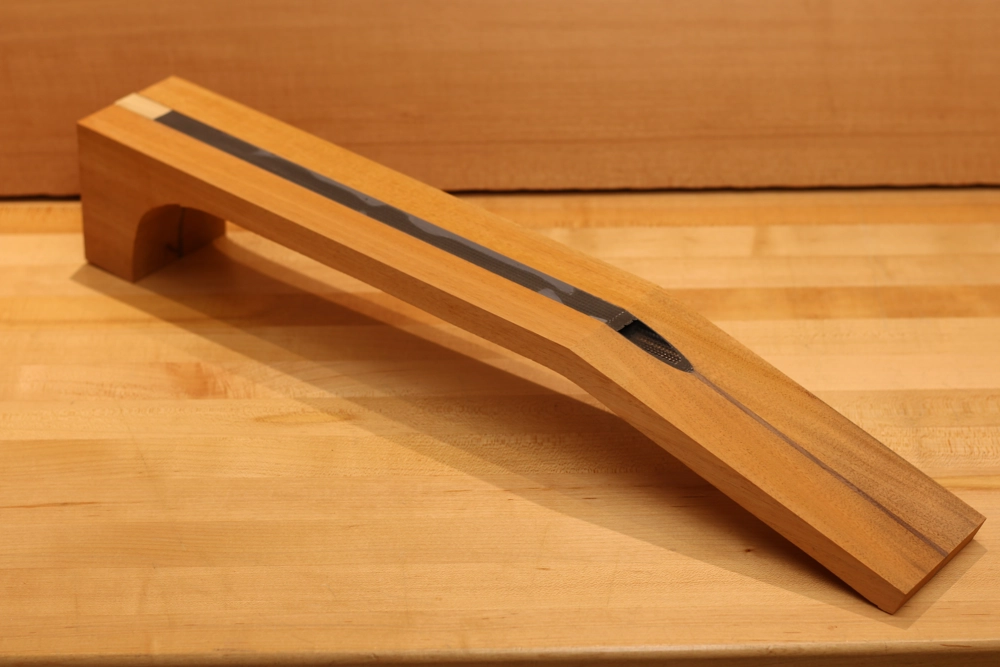
An early effort at preventing the neck from curling forward under steel string tension included a rigid, heavy hardwood beam that was embedded into the neck beneath the fretboard. Eventually, ebony sticks were replaced by various metal "sticks", including square tubes, angle irons (see photo, below) and H- or I-beams.
In addition to making a neck heavier, these approaches were not always successful in stabilizing the neck. Once such a reinforced neck was installed, the player got to live with the results. That means that if and when the neck bowed (and many of them did bow), they stayed that way. No amount of steaming or clamping could "adjust" them, however temporary such an adjustment might be.
The popularity of rigid reinforcements waned with the invention of the compression rod which, unlike its permanently fixed predecessors, offered some neck adjustability after installation. Like the embedded neck reinforcements they replaced, compression rods also needed to be affixed to the neck, at least partially (at the heel), and only offered adjustment in one direction (you could only introduce back bow to directly counter the pull of the strings).
Compression rods were soon superseded by the independent machines known as single-action truss rods. These also could only introduce back bow, but they did not require embedding one end of the rod within the neck heel; they simple rested in a groove in the neck. Of course, the pinnacle of achievement has been the advent of the dual-action truss rod, a variation of the single-action version. Using this machine, the player can manually curl the guitar neck both back and forward several times a minute, if so desired. I have dedicated an article to the topic, titled » The Truss Rod.
Over the years I have lost interest in providing "bow control" to my guitar necks. I have a different goal, that of preventing neck bow altogether. With a nod to the earliest of approaches, yet taking full advantage of modern technology, I prefer to use a non-metal, non-adjustable solution to resist forward bow. My current favorite solution makes use of a hollow carbon fiber fixture called the D-Tube. I have written this up in an article called » D-Tube by DragonPlate - Truss Rod Alternative.
I realize that many guitar makers have never actually repaired (rebuilt, remade, etc) guitars. Not that I think they should have, or should start doing so. But that is how I learned to construct guitars - by learning how to fix broken ones, reverse-engineering existing ones, and experimenting with attempts to improve guitars I was dissatisfied with.
Such experiences with acoustic guitars have shaped my perspective. I learned so much about the forces at work, forces that could destroy an instrument as easily as make it produce glorious sound.
Through trial and error (an expensive, but effective education) I found out firsthand what happens when guitars are under-braced, or soundboards are sanded too thin, or bridges are attached with insufficient adhesive, et cetera. I learned about overall string height early on, after shortening more than one saddle and shaving down more than one bridge and KILLING the output on more than one guitar. And then resetting the neck, replacing the bridge with a taller one, adding back the appropriately-sized saddle and Voila!, both the tone and amplitude are returned! I learned that action should be adjusted using neck geometry, not by sanding down saddles, and certainly not by tightening truss rods. In fact, got rid of the truss rods, altogether. I learned lots of things.
But I blew right past all that potential movement of the neck block! It wasn't until about a decade or so ago during one of my umpteenth neck resets that it suddenly hit me: Neck resets become necessary primarily as a result of permitting the body to flex, a condition I refer to as neck block shift. The neck block has moved away from its originally intended position in relation to the tail block, for however brief a moment, whether independently, or with the entirety of the upper bout attached. And I realized that there was something I could do about that. So I did!
I have written an article dedicated to this very issue, titled » Body Flexion - Neck Block Shift and Soundboard Shear. I encourage you to read it, as it lays a detailed foundation for what I touch on, below.
Perhaps you have witnessed a dog chase a squirrel up a tree and continue to bark up that same tree long after the squirrel has moved on to other trees? "Barking up the wrong tree" is a perfect euphemism to describe the (shall I say,) "misunderstanding" of the forces working on the neck block.
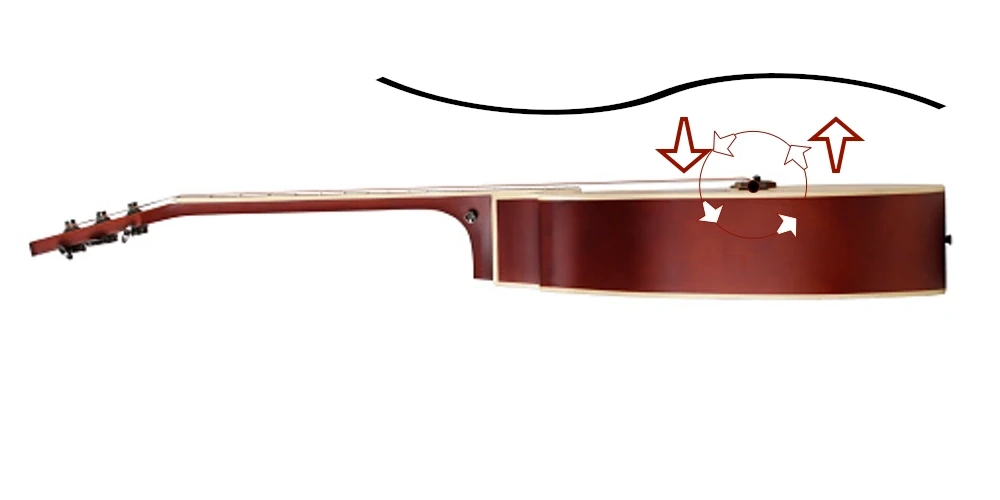
The pull of the strings on a guitar neck that is properly resisting forward bow, in addition to pulling the bridge in the direction of the headstock, is most assuredly also pulling that neck forward →, directly toward the soundhole (see my illustration, below). Unless you loosen the strings when you are not actually playing your guitar(s), a constant force is being applied to the instrument, whether you are playing it, or it is hanging on the wall, or sitting in a stand, or resting in its case.
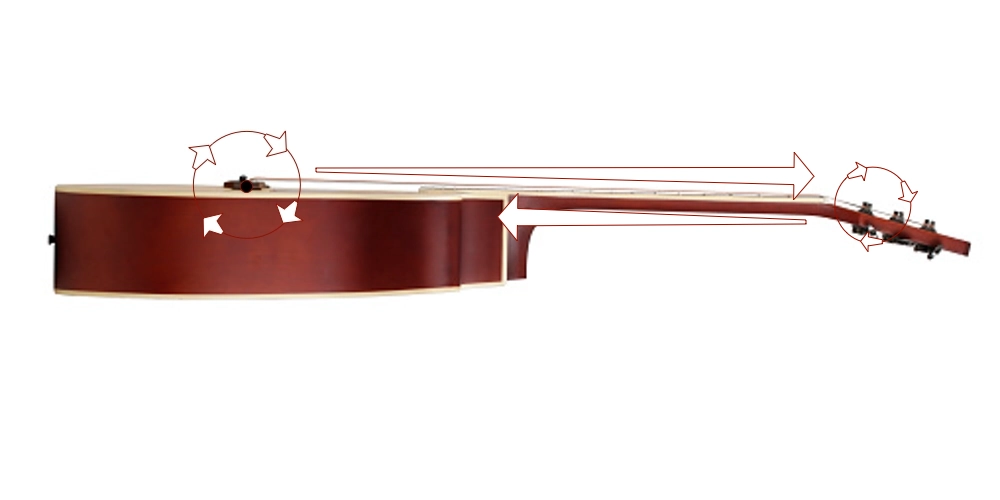
If that neck block (the bulwark, the buttress, the great wall that stops the neck from intruding into the body) moves (rotates, shifts, slips) even the slightest amount (measured in its original location in relation to the tail block), it will alter the neck geometry, typically resulting in a raised action, and ultimately resulting in severe damage. It is crucial to grasp that the neck block need not shift away from the body parts it is glued to in order to partake in what I am calling "neck block shift". If left flexible enough, the upper bout can compress and rotate, moving the neck block (even temporarily) out of position. Whether, like me, you consider this to be damage or not, you now most definitely have an issue with your guitar.
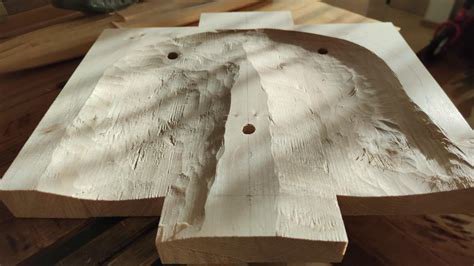
For a very long time, the body of the traditionally-constructed acoustic steel string guitar has been assembled using two (2) thin, bent, solid wood sides that are glued to hardwood blocks referred to as a neck block and a tail block. Kerfing (or kerfed lining) is added to the very edges of those sides in order to have something to attach the front and back plates to. See the photo, below.
Are you aware of just how flexible the shells built in this manner really are? Granted, the body firms up dramatically when the soundboard (front plate) and back are glued on. But history teaches us that movement, be it temporary or worse, will (and most assuredly does) still occur.
Once the body is complete, the neck of the guitar (typically built as a separate component on most steel string acoustics), is attached to the neck block using glue or bolts. The potential for movement of that neck block remains, as is evidenced by the continued need for neck resets/adjustments.
Imagine purchasing a pickup truck and learning that in n-number of years you are going need a truck bed reset, as the back of that truck is not going to remain where it was originally attached at the factory. Better yet, how about being resigned to the fact that your favorite touring sedan will require an engine block reset after so many miles?
Perhaps a better analogy would be to discover you can no longer enter your home through the front door without bending down to avoid bumping your head. You know it wasn't like this when you first moved in, so you ask a home building representative to come by for an inspection. You are informed that your house has simply shifted off its foundation. Upon learning of the age of the house, the rep nods knowingly, tells you the occurrence is quite common and hands you a color brochure titled, "Understanding Home Foundation Resets."
That all sounds patently absurd, doesn't it?
And yet, makers continue to build and players continue to purchase guitars whose necks are not going to stay where they were originally installed. This is the result of a design decision; a decision that is somehow okay because that is how it has been done for decades. I don't know about you, but THAT sounds absurd to me! The neck block should NOT be permitted to move.

Rather than continue to defend shortcomings as though those shortcomings were the original intent of the design instead of the unfortunate results, I choose to alter the design.
I don't want the body to flex, and I don't want the neck block to shift. This necessitates stabilizing the body.
Incorporating less-conventional modifications such as laminating the wooden sides, laminating the wooden linings, laminating the wooden neck and tail blocks and, perhaps more importantly, tying those blocks to one another, comes as close as I am aware of to achieving the immobility necessary to protect against the forces working to damage the guitar. Any combination of the above items is a step in the right direction, as far as I am concerned.
In my own builds, I have replaced the ubiquitous springy kerfing found in most all acoustic guitars with rigid, formed, laminated lining. I like to epoxy multiple strips of ≈ 1/16" x 1" (1.5 mm x 2.5 cm) Spanish Cedar together and press them into a mold. Having a bit wider lining allows for the safe installation of a bit wider binding which, in turn, can then be gently radiused for a more enjoyable playing experience.
HINT: Lining thickness must exceed the width of the binding/purfling rebate in order to avoid severing the soundboard off of the body. Make it as thick or thin as you desire, but please consider replacing flexible kerfing with laminated formed linings. After the epoxy dries, the lining emerges as a rigid, unified component that gets attached to the edges of the sides.
Traditionally, little attention has been paid to the forward movement of the neck block in relation to its position within the body. The neck was thought of as a lever, the fulcrum (hinge) being the point beneath the fretboard where the fretboard, neck heel and body all intersect. It was believed that, since the pull of the strings could cause a neck to bow forward, surely that same pull of those same strings must be trying to pivot the fretboard extension down into the body cavity. Builders responded by adding more support under the fretboard extension, resulting in both the Upper Transverse Brace and the Upper Transverse Graft (or "popsicle" brace), along with so-called "wing braces" in the Upper Bout. And yet, the need for neck resets continued, regardless.
I fell for this too, back in the early days, oh so many guitars ago. It wasn't until relatively recently that I realized that the trouble was with the linear force of the neck pushing forward into the body, not the rotational force (torque) that allegedly sought to plunge the fretboard extension straight down into the depths of the body. If I could prevent the neck block to which the neck is attached, from ever moving in relation to its original position, then torque would become irrelevant! In other words:
→ If the neck is disallowed from moving forward (towards the bridge), it cannot rotate downward!
Stop sanding (or bending, carving, spraying, stringing, or whatever else you are doing) long enough to consider the compressive force that neck is imposing on the soundboard. Rather than continue to rely on the soundboard to resist all this destructive force, and prevent the neck block from shifting, I employ carbon fiber rods to tie the neck block to the tail block.
The most direct means I have found of accomplishing this, of eliminating rotation of the neck block and, subsequently, preventing flexing of the upper bout of the guitar body, is to install (at a minimum) one rod nearest the soundboard and the second rod near the back of the guitar, and run those rods, in parallel, directly from the neck block to the tail block. An alternative to this, one that also eliminates torsion, is the installation of a larger, hollow carbon fiber tube that is permanently attached between the neck block and the tail block. These work great for offset soundhole designs.
For center soundhole soundboards, both approaches (two small diameter rods, or one large diameter tube) complicate access to the inside of the box. They prevent me from getting my arm inside the soundhole, required for access to bridgeplate transducers, for example. As an alternative, I can choose to create an access panel elsewhere, such as via the back or from the lower bout, but considerations accompany each approach.
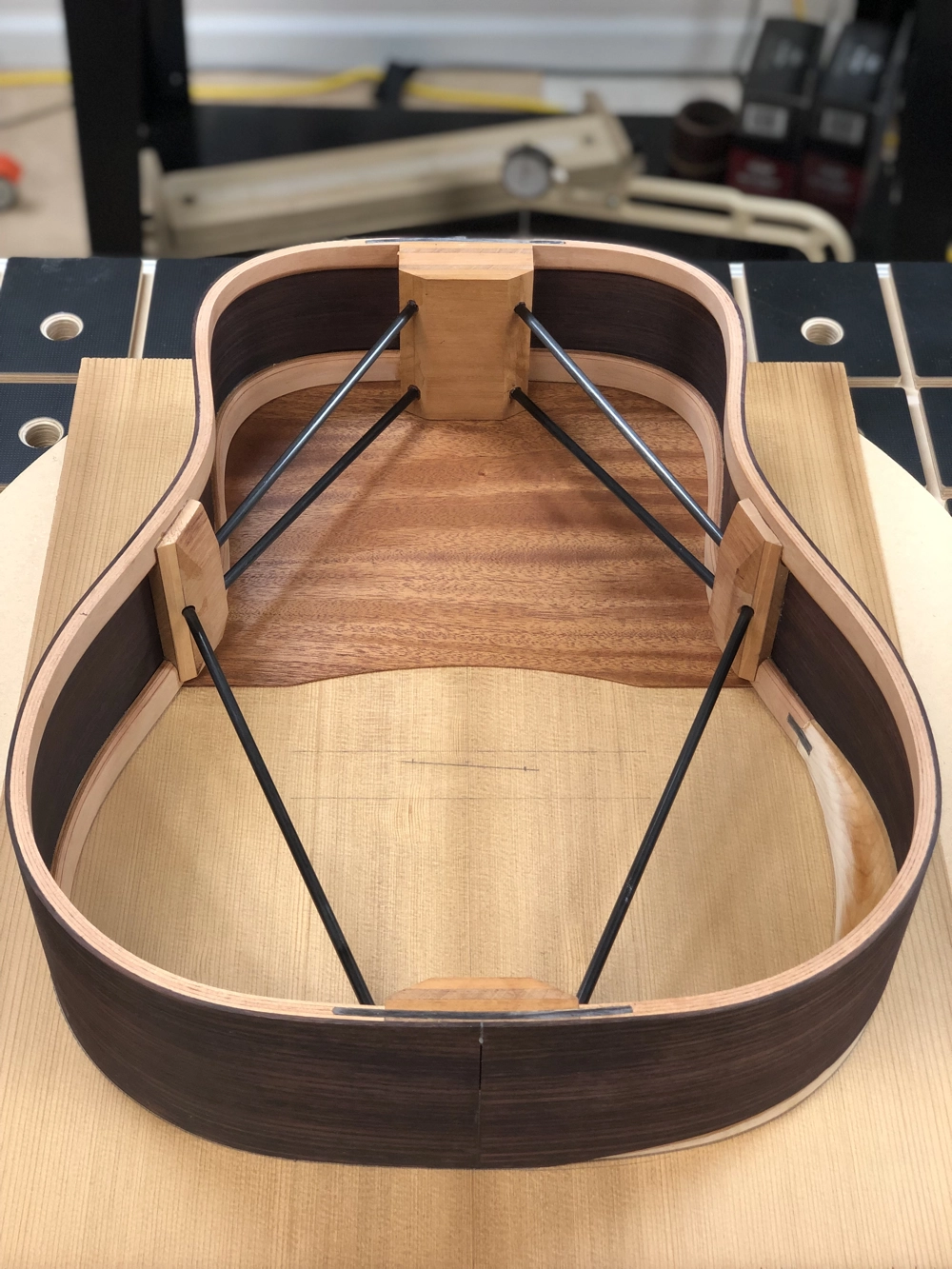
A compromise can be engineered that accomplishes my stabilization task AND maintains access to the interior. By diverting the path of the carbon fiber rods and securing them to the waist first, prior to continuing on to the tail block, the neck block is secured against rotation and the soundhole remains unobstructed. I first saw this approach taken by Rick Turner on one of his Compass Rose guitars. Below is a photo of a body shell that has been stabilized in this manner using laminated linings and carbon fiber rods:
Two rods run from each side of the neck block to corresponding blocks added to a point just behind each waist. For those who may be concerned that the linear force applied to the neck block and, subsequently, transferred on to the waist, will now blow out the sides, please pause long enough to take a glance at your favorite acoustic guitar.
You probably own, play, or are building guitars that have been constructed with extremely flexible shells, and rely solely on the front and back plates to stabilize all that body flexion. Most likely, you have been perfectly fine with that arrangement up until now with no concern of "blowing out the sides".
Those same two (2) plates, a soundboard and a back, are going to be added to the shell in the photo, above, the one reinforced with carbon fiber, and they will successfully prevent the sides from "blowing out." If you remain unconvinced and don't mind complicating access through the soundhole, you can tie one waist to the other with a cross piece. A removable solution might include a small cable with turnbuckle. I have not found that to be necessary (yet), but it is an easy option to incorporate.
In an effort to unify the neck and tail blocks I run an additional rod from the center of each waist block to each side of the tail block, terminating those rods toward the soundboard side of the tail block (not at its center). I am unaware of any rotational forces at work at the junction of the tail block and the back plate, so I don't add a second set of rods. These rods happen to be solid, not tubes, and are a whopping 1/4" (6.34 mm) in diameter. They more than get the job done! I hope to experiment at some point with an alternate, lighter design that supplies even greater rigidity to both blocks.
Is the effort worth it?
I ship guitars across the United States, year-round. They are tuned to pitch when they leave my shop. They arrive at their destinations still tuned to pitch, demonstrating their stability. Observable. Repeatable.
However you choose to design your guitar, focus on mitigating, if not eliminating, body flexion. Prevent the body from flexing and, subsequently, the neck block from shifting.
This is getting into the weeds a bit, but I have taken the whole "stability" issue much farther in my pursuit of what a soundboard might actually sound like when it isn't playing double-duty as a "steel-string tension resistance plate".
In addition to reinforcing the sides, I also like to reinforce the upper bout of the soundboard by applying hardwood veneer whose grain is oriented perpendicular to the soundboard's grain. Once the bracing has been added, that thicker section of the soundboard is "let in" to a recess in the shell, locking it in place. Gone is the need for any upper transverse brace, upper transverse graft ("popsicle brace"), wing braces, and soundhole braces. This approach has proven quite effective.
For guitars with fixed bridges, into or onto which the strings are anchored, the torque of multiple steel strings across the crest of the saddle is constantly working to rotate the bridge forward, in the direction of the headstock.
The builder must ensure a sufficient bond exists between the bridge and the soundboard to prevent the strings from tearing the bridge loose. The soundboard must have sufficient integrity to resist being torn off the guitar. It must maintain a bond with the bracing beneath it, and the bracing must be sufficient to minimize the effects of the forward rotation of the bridge. Additionally, a balance must be achieved between structural integrity and the freedom to translate string vibration into quality sound output.
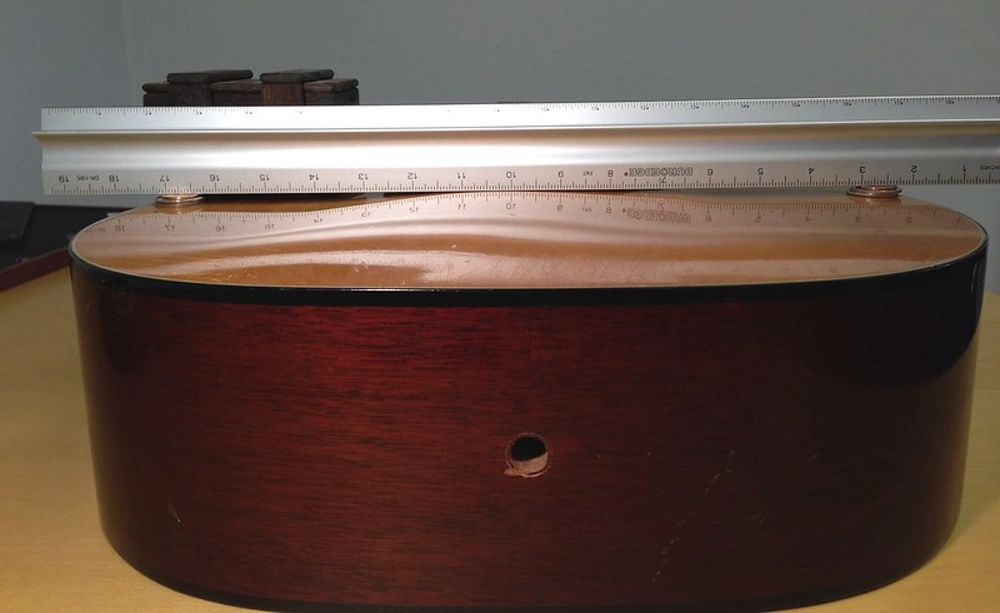
Builders consistently successfully accomplish all of these feats, and we have all enjoyed the results. Yet our bridges still rotate forward, some more than others, and (eventually) create a depression (however slight) in the soundboard in front of the bridge and a rise, or "belly", (however slight) behind it. The resulting "S" curve in the soundboard, viewable from the side, began life as a flat (or even slightly convex) plane.
This wavy top (that often exaggerates in appearance, over time) was NOT a deliberate design thought up by some brilliant, artistic luthier long, long ago. Instead, what we live with is called damage, a distortion of what started out as a flat plane.
The so-called "modern acoustic guitar" is constructed by intentionally re-creating a design that permits soundboard deformation. Yes, there is a certain range of "sound" associated with a top so constructed, and yes, most of the guitar world has no interest in altering much of anything - unless they thought of it, first. But that is beside the point. Rather than attempt to reduce or eliminate the role of the soundboard as a mitigator of collapse, many appear to prefer to think of (and even promote) such deformation as a feature.
Tailpiece-fitted guitars do not suffer from bridge rotation issues, due to the low-torque relationship between the strings and the saddle. The strings, anchored to the tailpiece (not the bridge), simply lay across the saddle and exert downward pressure only.
The situation is quite different, however, for instruments having fixed bridges into or onto which the strings are directly attached. Anchored toward the back of the bridge, directly behind the saddle, the strings pass up and over the saddle on their path up the neck to the headstock. A lever action is in effect, with the crest of the saddle acting as the fulcrum.
Tightening the tuning machines increases the tension of the strings, which applies a direct rotational force (torque) across the saddle. The rotation causes the back of the bridge (and the soundboard it is attached to) to lift upward, while the front of the bridge (and the soundboard it is attached to) wants to plunge downward. Strategically placed bracing mitigates soundboard deformation and collapse.
→ The degree of deformation your guitar will potentially experience is directly proportional to how it was constructed for the forces it will be subjected to.
A set of nylon strings may range from 60 lbs to 100 lbs of tension, comparable to the weight of a small ballerina. The total tension of six steel guitar strings might range between 140 and 190 pounds, depending upon the string gauge. 12-string guitar string tension can exceed 250 pounds. If you were to stand your guitar on its headstock, that amount of string tension is equivalent to having your average NFL player stand on the back of your bridge!
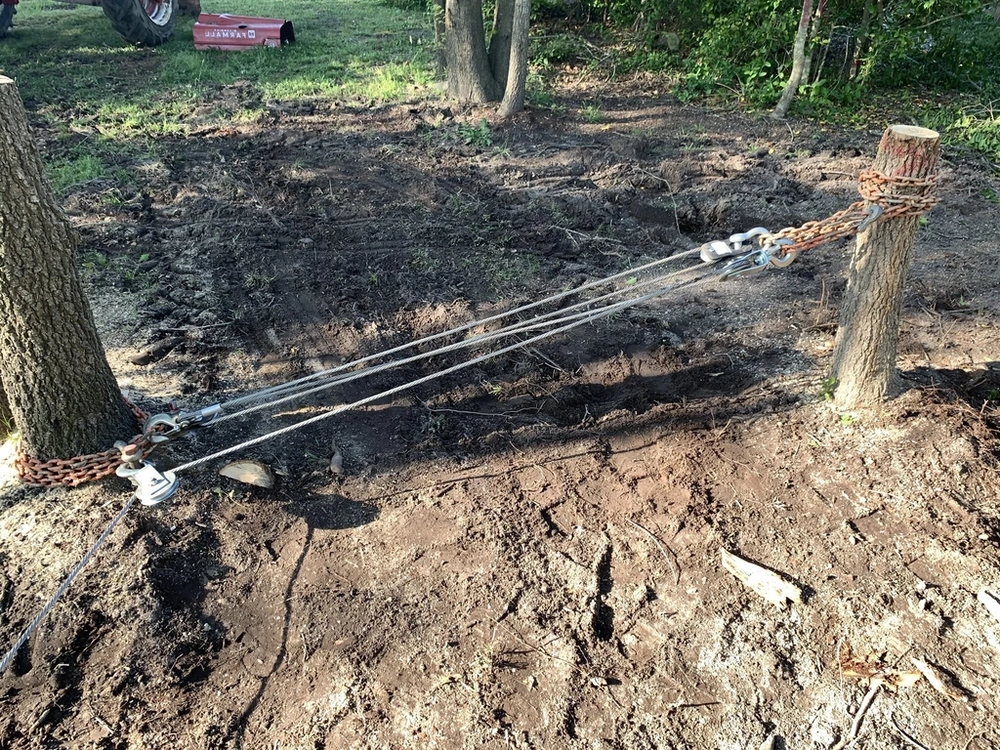
This forward rotation of the bridge can be visualized by setting up a block and tackle to remove the stump of a fallen tree, with the stump representing the bridge.
The stump is not airlifted straight up and out of the ground but, rather, tilts forward under the pull of the cable or chain. In the same manner, the glued-on bridge of the acoustic guitar rotates forward under the pull of the strings. Just as the ground behind the tree stump begins to rise as you rotate the stump forward, so the soundboard behind the bridge will lift, or "belly" upwards as the bridge rotates forward.
Pull on that bridge hard enough and it is quite possible to complete the analogy with the stump: you can literally tear the bridge (and, in some cases, the soundboard with it) right off the surface of the instrument. I speak from experience, having personally accomplished this feat! Twice!
As repair shops throughout the Earth will attest, if the soundboard and bracing are not deliberately functioning to prevent the front of the bridge from sinking below the surface plane established when the instrument was constructed, the forward rotation of the bridge will cause a depression and may eventually collapse the soundboard. If the soundboard and bracing provide insufficient support behind the bridge, this same forward rotation will raise the back of the bridge, and the soundboard it is glued to will raise right along with it.
Over the last half a century, I have encountered guitars with varying degrees of raised soundboards, or bellies. Many of them, though not all, sounded great to my ears, seemingly confirming the saying, "No belly, no tone!" I am proud to say that I own and have even built some of these deformed instruments.
I have also encountered as many or more guitars with little or no visually distinguishable belly that sounded just as great to my ears. I own (and have even built) some of these instruments, too.
If I think of bellying as a good thing, then I am unlikely to take further action.
If I think of bellying as a deformation of the structure of the guitar then, in lieu of rebuilding my guitar or purchasing a different one, I may seek to counter the effects of bridge rotation.
Belly can be mitigated by a number of means, including ensuring that any and all soundboard bracing remains adequately bonded to the underside of the soundboard for the life of the instrument. One can also increase stiffness in the soundboard to which the bridge is attached, such as by choosing to leave the soundboard a bit thicker, increasing its radius (arched dome), and/or enhancing the bracing.
In the event severe bellying has already occurred, short of replacing the soundboard, I may choose to attempt to flatten the bulge. I can apply heat and cauls or, even better, heated cauls and use clamping pressure to force the belly out of the soundboard.
However, unless I correct the condition(s) permitting the bridge to rotate and the soundboard to bulge, I will likely end up having to deal with it, again. To that end, I may choose to explore additional bracing options and/or bridge and bridgeplate replacement. Rarely is this an inexpensive solution.
So, you've selected the stiffest top plate you could find, left your top a little thicker than usual, glued all your bracing on, and even left a little extra bracing material after shaping. And you made sure to glue your bridge down properly. Problem solved, right?
If you mean, structurally speaking, then yes, you have likely resolved the problem of soundboard deformation and bellying due to forward bridge rotation. I mean, with sufficient bracing, most any elevated surface (floor, deck, bridge, guitar soundboard, etc) can be supported for whatever load it may be subjected to.
However, modifying any one of these soundboard-related elements in the name of deformation prevention will most assuredly have a direct impact on the sound of the guitar. You can definitely make your soundboard "stronger", but you may not be happy with the resulting sound.
The proverbial elephant in the room is the issue of relying on the soundboard for structural support. This is a big deal!
A chair maker sets out to construct a sturdy chair, one intended to support substantial weight. Making that chair comfortable is important, as is designing it to be aesthetically pleasing. But these goals are secondary to ensuring the chair does not collapse when sat in. The chair maker does not rely solely on the chair seat for structural support, as the forces at work are typically distributed to the legs.
By contrast, many acoustic guitar makers have seemingly accepted the role of the soundboard as a "steel-string tension resistance plate". Apparently, the musical aspect can be addressed, later.
Ironically, the front (or top) plate of the acoustic guitar is called a soundboard, yet the maker of the instrument only gets to live with the sound of the board as it presents itself AFTER the reinforcement tasks are fulfilled. Can you see how a luthier's skill is somewhat relegated to "tone recovery" efforts?
I have not set out to cast aspersions on the veracity of traditional lutherie. I fully acknowledge that many builders have most earnestly and quite successfully pursued that perfect balance between traditional structural support and sound generation, creating instruments that are as delicate as they are beautiful. I am one of them. I have built some really impressive examples. I own, have played, and have heard even more impressive examples from others.
I contend that, when building today's steel string acoustics, we have settled for a compromise between the structural support needed to prevent collapse and the lightest possible build to generate the most pleasing sound(s), all due to the belief that structural support is, and must remain, the role of the soundboard.
Roadworthy guitars are deliberately constructed to be more durable. They are most likely amplified using pickups, and the emphasis is on sturdiness. Studio-worthy instruments, by contrast, are typically built with a focus on acoustic properties, and are perhaps more delicate. Regardless of whether a given instrument is destined for the road or the studio, guitar makers must lean a bit more towards the structural integrity side of things due simply to good business principles when dealing with consumer goods (aka: warranty claims).
Building "lighter" typically translates to "more fragile" and "more expensive". Progress-wise, we have pretty much boxed ourselves into a corner as the result of a design decision made decades ago.
Why not try something different?
More to come ...