The days right after Christmas provide for a particular time of reflection. The somber realization that another year is winding to a permanent close is replaced by the anticipation for the celebration of the new year about to begin. It was during this special time in 2012 that I was able to spend a Saturday with master luthier John Greven.
I was in my hometown of Portland, Oregon over the holidays and contacted a delightful fellow Guild 12-string aficionado, Duffy Calloway. He is the proud owner of a fabulous guitar built in the 60s with an even more fabulous story to accompany it. Duffy invited me over to a friend’s house to see the instrument and jam a little. That friend was John Greven.
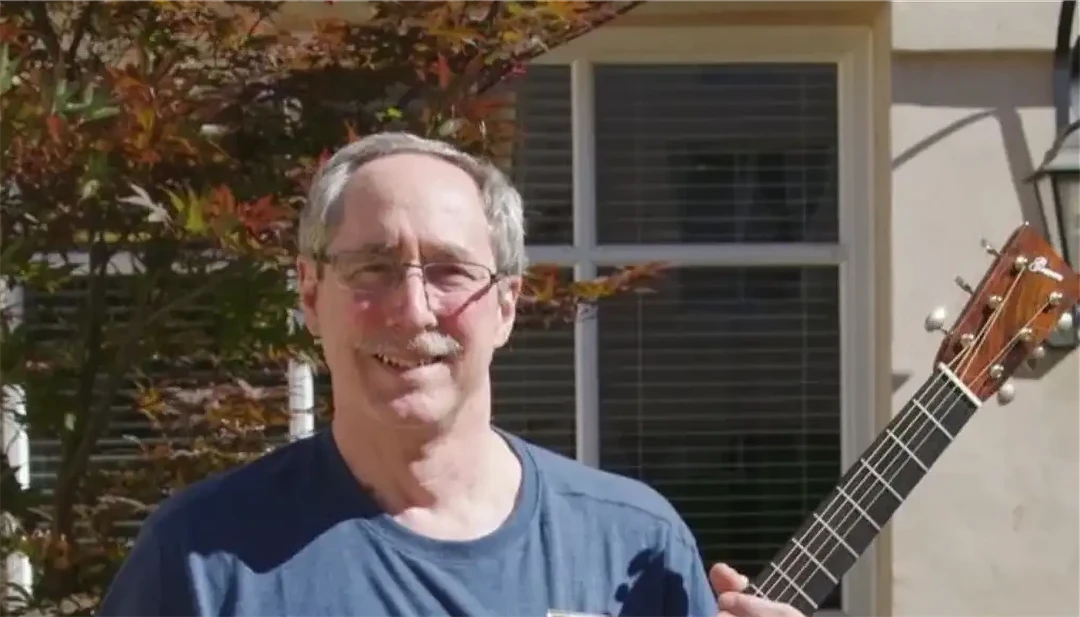
John, at Home
I am the proud owner of a 2005 Greven Nick Lucas with Brazilian Rosewood back and sides, which I am rather fond of. I was thrilled to have the opportunity to spend this time with its creator.
John and Duffy met me on the front porch of John’s immaculate and lovely home, situated on a classic tree-lined street in SE Portland. I had brought along a Taylor K-24ce (all Koa 6-string) that I was traveling with and opened up the case straightaway upon entering. I played a few instrumentals and shared some life adventures. John graciously commented on the surprisingly well-balanced sound of the Taylor, which I handed to him for closer scrutiny.
Next up was Duffy’s glorious Guild 12 string. This circa 1960’s F-512 was one of 2 special guitars made, both having Brazilian Rosewood back and sides, the other having been purchased by John Denver. This guitar was such a delight to play. Guild jumbo’s are loud by design, and can be ‘boomy’.
This 12-string was loud, but the brilliance of the tone made for anything but a boomy experience. It was a shimmery orchestra on my lap, and it’s sound brought smiles to faces of everyone present that morning. Duffy is a good player, and it was a lot of fun to listen to him make that Guild talk!
Duffy and his Guild
Prior to my arrival, John had brought several of his own guitars into his dining room, each still housed in it’s respective case. It was at this point that he began to select one instrument at a time and hand to me to play. What an honor, to be sitting in this humble man’s home playing his incredible creations.
One astonishing guitar after another, I was nearly an emotional wreck when John handed me one of the two smallest of the instruments I would play that day. These were his short-scale 12-fret models based on a Martin 00-28. Both were outfitted with John's favorite soundboard tonewood: Lutz Spruce.
The first of the 00s that I played had gorgeous Flamed Maple back and sides. The guitar was small and light enough that I had to reposition it in my lap, classical guitar style, which amused John. My jaw dropped in admiration as the first notes rang out and John laughed, saying that was the exact expression he has witnessed on the face of everyone who has played these instruments. No doubt!
The second guitar was essentially identical, though the back and sides were Brazilian Rosewood. As I began to play, the guitar began to quiver in my arms, the sound reverberated in my chest, and tears began to fill my eyes. Wow, what a guitar! Pure quality. Both of these 00 guitars were exceedingly LOUD! Not just for their size. They were really LOUD instruments, such that I actually needed to play more softly.
Duffy had to leave, so John and I spent the rest of the day in his shop, located in the basement of his home. I have no photos, but I remember the layout quite well. John's prep and assembly all took place along one wall of a narrow section of the basement.
I recall being unable to locate even the tiniest available wall space above his continuous, wall-length bench. Every shelf, nook and cranny was taken with one tool, or another. Not that he would have had room for one, but he didn't use a go-bar deck. Instead, he clamped his bracing in place on solera-style plates.
John used a hot pipe (a literal pipe with a propane torch) with a damp towel for bending. His spray station vented to the outside using a box fan. He had switched to water-based finishes years earlier, so he had no flammability concerns.
He shaped his necks by hand in an adjoining room/area, using a stationary belt sander. I had never seen a neck produced that quickly, that well, not in all my life! In addition to a bandsaw, the other piece of machinery in John's shop was a large motorized turntable he used for rapidly shaping the radius into the kerfed sides of his guitars.
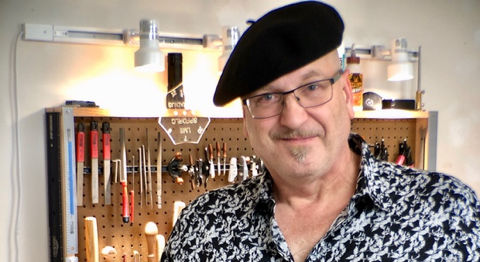
Two Outstanding Luthiers
An old photo of John Greven and Kent Everett, at the Oregon coast. These two men have added the most to my knowledge of guitar making.
John Greven and Kent Carlos Everett